Nationwide ECHO Study Suggests Children in the Western and Southern U.S. May Have Lower Body Mass Index Than Children in the Northeast

<< Back to Research Summaries

Nationwide ECHO Study Suggests Children in the Western and Southern U.S. May Have Lower Body Mass Index Than Children in the Northeast

Author(s): Dana Dabelea, Jody Ganiban, Traci Bekelman, et al.


Who sponsored this study?

This research was supported by the Environmental influences on Child Health Outcomes (ECHO) program, Office of The Director, National Institutes of Health.


What were the study results?

BMI was lowest for children in the West and South compared to those in the Northeast. When demographic differences were accounted for, children in the Midwest had higher BMIs than those in the Northeast. Across all regions, BMI was highest in children who weighed more at birth and children with less educated mothers. In the Northeast, South, and Midwest, non-Hispanic Black children had higher BMIs on average compared to non-Hispanic white children. In the South and West, BMI was higher for Hispanic white children compared to non-Hispanic white children.


What was the study's impact?

This study revealed some of the regional and demographic factors influencing childhood obesity and overweight. The regional differences in children’s BMI suggest that their surroundings, cultures, and relationships affect the development of childhood obesity. These differences could potentially be linked to variations in food prices, fast food options, and opportunities to exercise.


Why was this study needed?

About 35% of US children are overweight or obese. Childhood obesity can have serious physical and mental health effects that can follow children into adulthood. Understanding the factors that affect children’s weight, can help us create ways to prevent obesity. This study looked at factors related to children’s weight where children live, how much they weighed at birth, and their ethnic background.


Who was involved?

This study included more than 14,000 children and teenagers from birth to age 15. The children lived in the West, South, Northeast, and Midwest regions of the United States. The study included children from different racial and ethnic backgrounds. About half of the children were girls.
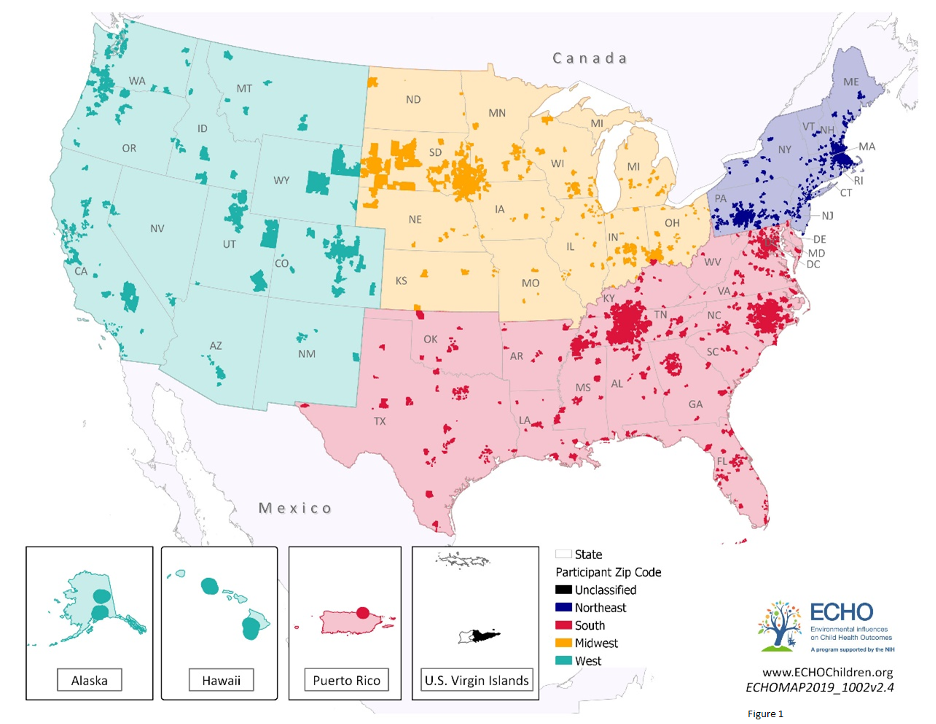
 

Figure 1 This image shows the different regions of the Unites States where study participants lived.


What happened during the study?

Doctors measured children’s height and weight from 2000-2018. The research team used this information to calculate each child’s body mass index (BMI), which is an approximate measure of body fat based on height and weight. The team compared differences in average BMI based on region, mother’s level of education, and demographic factors, including birth weight, race, ethnicity, and sex.


What happens next?

More research is needed to understand exactly how regional environments and policies impact children’s BMI and how local policies contribute to differences in obesity risk based on demographics. Identifying the regional and social factors that result in increased obesity risk can help policymakers and public health officials create ways to prevent obesity.


Where can I learn more?

Access the full journal article, titled “Regional and Sociodemographic Differences in Average BMI Among U.S. Children in the ECHO Program” in Obesity.

The content is the responsibility of the authors and does not necessarily represent the official views of the National Institutes of Health.


Published: August 31, 2021


Access the associated article.

read more summaries here:

Which Children Develop Asthma in the US

Author(s): Christine Cole Johnson and Aruna Chandran

How Environmental Exposures Affect Child Health Across Multiple Generations

Author(s): Carrie Breton, Rebecca Fry, Alison Hipwell, Cristiane Duarte, Linda Kahn, and Joseph Braun

Can Maternal Chemical Exposures Affect Birth Weight?

John Pearce
John Pearce, PhD
Medical University of South Carolina

Pregnant women often encounter numerous chemicals that may pose a risk to them and their baby. A subset of these chemicals are endocrine disrupting chemicals (EDC), which can affect health outcomes including growth and development, organ function, metabolism, and reproduction. Thousands of manufactured chemicals in use today are EDCs, and exposures to them are often studied individually. However, this approach is limited since mothers often encounter multiple chemicals in combination (a.k.a., mixtures) during the course of their pregnancy.

To further investigate exposure combinations to EDCs, ECHO researcher John Pearce, PhD of the Medical University of South Carolina and his research team developed a new methodology defined as exposure continuum mapping (ECM) that leverages spatially correlated learning for investigating complex exposure patterns (a.k.a. mixtures) in health studies involving numerous exposures. With this study, Dr. Pearce and his team apply ECM to data collected from a diverse mother-child cohort to identify exposure profiles of real world EDC mixtures and to assess how the discovered profiles associated with birth outcomes.

To begin, the team used data previously collected from over 600 women participating in ECHO that also enrolled in the Eunice Kennedy Shriver National Institute of Child Health and Human Development’s (NICHD) Fetal Growth Studies from 2009-2012. These data included concentrations of EDCs measured in blood samples collected from mothers 8-12 weeks into their pregnancy and their infant’s weight at birth. Then, the team analyzed these data with ECM in order to identify the range of EDC exposure profiles experienced by moms during their pregnancy and to examine the relationship to the birth weight of their children.

Findings from the study revealed that moms experienced a broad range of chemical exposure profiles with marked variability in exposure magnitudes across chemical classes and exposure frequencies. Evaluation of health effects found that maternal exposure profiles dominated by higher levels of flame-retardants (i.e., polybrominated diphenyl ethers, PBDEs) were associated to lower birth weights. Exposure profiles with higher levels of polychlorinated biphenyls (PCBs) and perfluoroakyl (PFAS) substances were associated with increased birth weights. PCBs are man-made chemicals that are often found in industrial and commercial products, such as electrical and hydraulic equipment and plasticizers in paints, plastics, and rubber products. PFAS substances can often be found in food packaging, commercial household products, drinking water, and living organisms.

“ECM provides a promising framework for supporting studies of other exposure mixtures as the resulting mapping benefits visualization and assessment of relationships in complex data,” said Pearce. “Moving forward, our team will apply ECM to assist investigations of exposure mixtures and other child health outcomes, with particular interest on obesity.”

Read the research summary.

Series Highlighting ECHO Program Now Available in Pediatric Research

Pediatric Research recently published a series of articles highlighting the ECHO Program’s progress. In the introductory article, titled “The NIH ECHO Program: investigating how early environmental influences affect child health,” the NIH Program Office provides a broad overview of the program and its achievements to date. The second and third articles, written by members of the ECHO Coordinating Center (CC) and various ECHO investigators, focus on the program’s construction, challenges overcome during development, and the scientific opportunities that have already resulted from ECHO’s uniquely broad dataset.

The introductory article highlights the origins of the ECHO Program, dating back to September 2016. Authored by members of the NIH Program Office, this article details the breadth of the ECHO Program’s national network of cohorts, which includes 57,000 children and over 1,200 researchers participating through observational and interventional research. This piece also outlines program goals, including ECHO’s commitment “to enable high-impact research evidence that will inform clinical practices, policies, and programs for child health; and establish a national data platform and biorepository for the scientific community.”

Given its size and span, the program faced unique challenges. To tackle these head-on, governing committees facilitated the establishment of several specialized working groups to address challenges and direct the program in pursuing its goals. For example, the purpose of the Team Science Working Group was to “maximize ECHO’s scientific excellence and productivity by fostering team building and collaboration through effective communication.”

Another logistical challenge that ECHO faced from the beginning was the coordination of a dispersed set of established pediatric cohorts and the harmonization of their existing data to create a nationwide standardized dataset. As many of these individual cohorts had their own research focal points and routine sets of measurements, building a consistent dataset required ECHO to develop a unified set of required measurements and standard protocols. From this problem came the Protocol Working Group.

ECHO aims to enhance the health of children and adolescents through research that may help inform healthcare practices, programs, and policies. The third article details program strategies for fostering solution-oriented research that helps accomplish this goal, some of which include promoting ECHO research through publications and Opportunities and Infrastructure Fund (OIF) grants.

In the five years since its inception, the ECHO Program has made great strides in the development of a diverse, nationwide pediatric research framework with the power to inform children’s health policies and practices. Its large, varied population of participants, emphasis on multidisciplinary science, and capacity for pioneering innovative methods and technologies have shaped the program into an unprecedented resource in pediatric research.

“ECHO represents exciting new opportunities for pediatric research,” the third article concludes, “allowing for the investigation of scientific questions related to less common childhood outcomes and increasing inclusiveness of children participating in research in the United States.”

Dana Dabelea: Developmental Origins of Pediatric Obesity and Diabetes- What We Know and Don’t Know

return to discovery home

Developmental Origins of Pediatric Obesity and Diabetes- What We Know and Don’t Know

Speakers:

Dana Dabelea, MD, PhD

Professor of Epidemiology and Pediatrics, and Director of the Lifecourse Epidemiology of Adiposity and Diabetes (LEAD)

University of Colorado at Denver


Speaker Bio: Dr. Dabelea, MD, PhD is Professor of Epidemiology and Pediatrics, and Director of the Lifecourse Epidemiology of Adiposity and Diabetes (LEAD) Center at the University of Colorado Anschutz Medical Campus (UC AMC). She is a national leader in studies of the prenatal and postnatal developmental, environmental and behavioral factors contributing to childhood obesity, metabolic syndrome and diabetes, and their consequences throughout the lifespan. Her experience includes perinatal, pediatric and adult studies with community-based and clinic-based sampling, and longitudinal follow-up. As Director on the LEAD Center she oversees several NIH and CDC -funded grants totaling a budget of over $ 18 million. Dr. Dabelea has a record of engaging and mentoring students, fellows and junior faculty across many research projects. Dr. Dabelea is a recipient of the UC AMC Graduate School’s Mentoring Award, the American Diabetes Association Kelly West Award for Epidemiology, and UC System Elizabeth D. Gee Memorial Lectureship Award, which recognizes and honors an outstanding faculty member of the University of Colorado for efforts to advance women in academia, interdisciplinary scholarly contributions, and distinguished teaching. She received her MD degree (1990) and her PhD degree in Clinical Sciences (1997) from the University of Medicine and Pharmacy Timisoara, Romania.

Date: Tuesday, April 13 , 1 to 2pm


Ann Davis: “Updates to a Trial as a Result of COVID: iAmHealthy in the ISPCTN”

link discovery home

Updates to a Trial as a Result of COVID: iAmHealthy in the ISPCTN

Speakers:

Ann Davis, Ph.D., MPH, ABPP

University of Kansas Medical Center


Speaker Bio: 

Ann Davis graduated from the University of Kansas with degrees in both Psychology and English. She go her PhD in Clinical Psychology at Western Michigan University, and completed her psychology internship at Father Flanagan’s Boys Home in Nebraska. After a two year research fellowship at Cincinnati Children’s Hospital Medical Center she returned to her native home in Kansas, to accept a faculty position at the University of Kansas Medical Center in the Department of Pediatrics.

Ann founded the pediatric obesity program at KUMC called Healthy Hawks, studying healthy lifestyles in children. Ann and her team have attained funding from the National Institutes of Health and other federal agencies.

Date: Wednesday, December 9, 1 to 2pm

International Journal Highlights ECHO’s Novelty and Necessity in Obesity Research

A recent article on childhood obesity in the US, published in the International Journal of Obesity, details results from an ECHO study of more than 37,000 babies and kids and describes the unique features that make the ECHO Program exceptionally valuable for obesity research.

The authors note that ECHO “holds promise to provide insight into the mechanisms that promote overweight and obesity in US children and provides rigorous data for novel programs to lessen the burden on individuals, families, and society.”

The study found that overweight and obesity were more common in older children than in younger children and varied with race/ethnicity. About 1 in 10 children age 1 to <2 years had a high BMI, and about 1 in 3 adolescents age 12 to <18 years was overweight or obese. Hispanic and black children had the highest rates of both overweight and obesity.

The results were similar to those from the large National Health and Nutrition Examination Survey (NHANES), pointing to the generalizability of ECHO’s population for further obesity research.

Despite the growing obesity epidemic, few programs provide an accurate insight into the many factors that promote overweight and obesity in children in the United States. However, due to the diversity and size of the ECHO Program’s population, it is well positioned to provide a comprehensive view of the impact of various environmental influences on childhood obesity.

“ECHO has assembled a large racially/ethnically diverse US cohort poised to provide much-needed answers to important questions regarding the early life determinants of childhood obesity risk,” the article states.

Because of the program’s size, it will have the statistical power to answer questions about environmental and preventable causes of childhood obesity even for less common exposures. Through the collection of existing and forthcoming data, ECHO also has the ability to examine genetic modifications and unravel the complexity of gene-environment interactions as contributors to obesity.

Find more information on ECHO research at echochildren.org/about.

Leo Trasande: Endocrine Disrupting Chemicals: A Costly Public Health Threat with Opportunities for Policy Prevention

return to discovery home

Endocrine Disrupting Chemicals: A Costly Public Health Threat with Opportunities for Policy Prevention

Speaker:

Leo Trasande, MD, MPP

NYU School of Medicine, Professor of Pediatrics


About the Speaker:
Leonardo Trasande, MD, MPP is a professor in the departments of Pediatrics, Environmental Medicine, and Public Health at New York University, and is a leader in children’s environmental health researcher. His research focuses on the roles of environmental exposures in childhood obesity, and on the economic costs of failing to address these environmental factors to prevent diseases in children proactively.

Dr. Trasande received his bachelors, medical, and public policy degrees from Harvard University. He also completed the Boston Combined Residency in Pediatrics and a legislative fellowship in the Office of Senator Hillary Rodham Clinton.

Outcome Areas: Obesity; Neurodevelopment

Date: Tuesday, October 15, 1 to 2pm