



NIH Program Study Finds Increased Weight Gain in Children During the COVID-19 Pandemic

FOR IMMEDIATE RELEASE


Children gained weight at a faster rate during the COVID-19 pandemic compared to previous years, according to a new study funded by the Environmental influences on Child Health Outcomes (ECHO) Program at the National Institutes of Health.

Childhood obesity is a serious health condition that can affect long-term health and quality of life. At the beginning of the COVID-19 pandemic, health experts were concerned that the closure of schools and recreational facilities could cause an increase in childhood obesity due to a reduction in physical activity and dietary changes.

ECHO researchers analyzed changes in children’s body mass index (BMI) before and during the pandemic and investigated whether changes in BMI varied based on race, ethnicity, prepandemic BMI, or household income. In general, children gained weight at an increased rate during the pandemic but children in higher income households were at a lower risk of excess weight gain.

“This study highlights the need for interventions to mitigate the physical and mental health consequences of the COVID-19 pandemic,” said Emily Knapp, PhD. “The conditions faced by families during the COVID-19 pandemic may have led to an acceleration of weight gain in children. This study highlights the need to support less resourced families, who have borne the worst consequences of the pandemic.”

Dr. Knapp and Aruna Chandran, MD, ECHO Program investigators at Johns Hopkins Bloomberg School of Public Health, led this collaborative research effort published in Pediatrics.

Knapp, E. A. et al. Changes in BMI During the COVID-19 Pandemic. DOI: 10.1542/peds.2022-056552

###

About ECHO: ECHO is a nationwide research program supported by the NIH. Launched in 2016, ECHO aims to enhance the health of children for generations to come. ECHO investigators study the effects of a broad range of early environmental influences on child health and development. For more information, visit echochildren.org.

About the NIH: NIH, the nation’s medical research agency, includes 27 Institutes and Centers and is a component of the U.S. Department of Health and Human Services. NIH is the primary federal agency Emily Knapp, PhD Aruna Chandran, MD conducting and supporting basic, clinical, and translational medical research, and is investigating the causes, treatments, and cures for both common and rare diseases. For more information, visit www.nih.gov.

Media Contacts

For information or to request an interview, contact Rebekah Yeager,  rebekah.yeager@nih.gov.

If you are not a member of the media, but have a general inquiry, please contact  NIHKidsandEnvironment@od.nih.gov.

Connect With Us

echo connectorCheck out the recent issues of our bi-monthly newsletter, the ECHO Connector, for program news and the latest research findings.

To receive the ECHO Connector through email, subscribe here.

Follow @ECHOChildHealth for the latest ECHO Program updates on Twitter.

ECHO Researchers Investigate Child Weight Gain During the COVID-19 Pandemic

Collaborative ECHO research led by Emily Knapp, PhD and Aruna Chandran, MD of Johns Hopkins Bloomberg School of Public Health investigates the effects of the COVID-19 pandemic on children’s body mass index (BMI), an estimation of overall body fat. The study looked at the BMI of 1,966 children ages 2 through 18 years old from 38 ECHO cohorts across the United States during the COVID-19 pandemic. The results of this study suggest that, on average, children gained weight at a higher rate during the pandemic. This research, titled “Changes in BMI during the COVID-19 Pandemic,” is published in Pediatrics.

Childhood obesity is a serious health condition that can affect long-term health and quality of life. At the start of the COVID-19 pandemic, there was concern among researchers and doctors that the closure of schools and the cancellation of recreation and sport activities would cause an increase in childhood obesity.

To understand the pandemic’s impact on children’s weight, researchers analyzed yearly changes in children’s body mass index (BMI) before and during the pandemic, considering each child’s age and sex. The researchers also investigated whether changes in BMI were different across specific sociodemographic traits including race, ethnicity, pre-pandemic BMI, and household income.

The results of this study indicated that on average children gained weight at an increased rate during the pandemic, and children who had obesity before the pandemic gained weight at a faster rate compared to children who were at a healthy weight pre-pandemic. Additionally, children in higher income households were at a lower risk of excess BMI gain during the pandemic.

“This study highlights the need for interventions to mitigate the physical and mental health consequences of the COVID-19 pandemic,” said Dr. Knapp. “The conditions faced by families during the COVID-19 pandemic may have led to an acceleration of weight gain in children. This study highlights the need to support less resourced families, who have borne the worst consequences of the pandemic.”

Future studies can explore strategies to help families and communities thrive amidst the challenges faced during the ongoing COVID-19 pandemic. As the pandemic continues to alter children’s lives, it will be important to monitor changes in health outcomes among children and use these data to build programs to reduce health inequities.

Read the research summary.

During the COVID-19 Pandemic, Children Gained Weight Faster

<< Back to Research Summaries

During the COVID-19 Pandemic, Children Gained Weight Faster

Authors: Emily Knapp, Aruna Chandran, et al.


Who sponsored this study?

This research was supported by the Environmental influences on Child Health Outcomes (ECHO) program, Office of The Director, National Institutes of Health.


What were the study results?

Results from this study show that during the COVID-19 pandemic, children gained weight at an increased rate compared to the years before the pandemic. Children who had obesity before the pandemic gained weight at a faster rate during the pandemic compared to children who were in a healthy weight range pre-pandemic. Children in higher income households were at a lower risk of excess weight gain during the pandemic.

Footnote: Results reported here are for a single study. Other or future studies may provide new information or different results. You should not make changes to your health without first consulting your healthcare professional.


What was the study's impact?

This study highlights the need for programs and services to prevent and reduce the physical and mental health effects of the COVID-19 pandemic on children.


Why was this study needed?

Childhood obesity is a serious health condition that can affect long-term health and quality of life. There was concern among researchers and doctors that the COVID-19 pandemic may cause incidence of childhood obesity to increase due to the closure of schools and cancellation of recreational activities, leading to less physical activity and changes in eating habits.


Who was involved?

This study included 1,966 participants ages 2 through 18 years old from 38 ECHO cohorts across the United States.


What happened during the study?

The researchers compared annual changes in children’s body mass index (BMI)—a measure used to estimate body fat—before and during the pandemic. The researchers also took into account child’s age, sex, race and ethnicity, pre-pandemic BMI, mother’s education, and household income.


What happens next?

Future studies should explore strategies to support families during the COVID-19 pandemic. As the pandemic continues to alter children’s lives, it will be important to monitor changes in health outcomes among children and use these data to build programs to reduce health inequities.


Where can I learn more?

Access the full journal article, titled “Changes in BMI during the COVID-19 Pandemic” in Pediatrics.


The content is the responsibility of the authors and does not necessarily represent the official views of the National Institutes of Health.

Published June 30, 2022


Access the associated article.

Read More Research Summaries about Obesity and COVID

The Relationship Between Prenatal Obesity and Child Autism-related Social Behaviors

Author(s): Kristen Lyall, Christine Ladd-Acosta, et al.

Youth Well-being During COVID-19

Author(s): Courtney K. Blackwell, et al.

ECHO Researchers Report Higher Levels of Oxidative Stress among Socioeconomically Disadvantaged Pregnant Women

A collaborative research effort led by Stephanie Eick, PhD, MPH of Emory University’s Rollins School of Public Health and Rachel Morello-Frosch PhD, MPH of the University of California, Berkeley investigated the relationship between various biological, behavioral, and social factors and higher levels of oxidative stress in pregnant women, which is often associated with poor prenatal health outcomes. Pregnant participants who were 30+ years old and had a college degree had lower levels of oxidative stress. In contrast, levels of oxidative stress were higher among pregnant participants who were overweight or obese, or unmarried. Levels of oxidative stress biomarkers were also higher among pregnant participants who were current smokers or had less than a high school education.

This research, titled “Associations between social, biologic, and behavioral factors and biomarkers of oxidative stress during pregnancy: Findings from four ECHO cohorts,” is published in Science of the Total Environment.

To measure oxidative stress, the researchers collected urine samples from approximately 2,000 pregnant participants in the mainland United States and Puerto Rico who were enrolled in one of four ECHO cohorts. They measured the levels of oxidative stress biomarkers at up to three time points during pregnancy and calculated the association between biomarker levels and biological, behavioral, and social factors. Maternal age, pre-pregnancy body mass index, marital/partnered status, parity, and smoking status were included as biological and behavioral factors while race/ethnicity, maternal education, and stressful life events were considered social factors.

“This is the largest study to date to examine the relationship between biologic, social, and behavioral factors and oxidative stress during pregnancy,” said Dr. Eick. “Our results provide important clues into how social and economic inequalities lead to poor health in pregnant women.” This study may also inform future studies looking at risk factors for preterm birth.

As for ongoing research, the team is examining the impact of oxidative stress on adverse pregnancy outcomes, such as preterm birth.

Read the Research Summary.

NIH Program Study Finds Association Between Prenatal Obesity and Child Autism-Related Behaviors

FOR IMMEDIATE RELEASE


According to a new National Institutes of Health (NIH)-funded study, there may be an association between certain conditions during a mother’s pregnancy, such as obesity and gestational diabetes, and Autism Spectrum Disorder (ASD)-related behaviors in childhood.

The study included nearly 7,000 participants from 40 NIH Environmental influences on Child Health Outcomes (ECHO) cohorts. Eight of the cohorts included participants with increased likelihood of ASD. Researchers collected data on maternal health conditions during pregnancy, child autism-related social behaviors, and participant demographics.

The study suggested that maternal obesity and gestational diabetes were associated with indicators of autism-related social behaviors. Investigators did not see increases in these behaviors for children of mothers with preeclampsia or gestational hypertension. There was no strong evidence to suggest that ASD-related traits were related to preterm birth or low birth weight, which are common complications of these pregnancy conditions.

Learn more about this research through the affiliated flash talk.

“Investigating how exposures, health conditions, and risk factors relate across the full range of the outcome distribution may help us learn more about the nature of these relationships and their impact on the population,” said Kristen Lyall, ScD of Drexel University.

Dr. Lyall and Christine Ladd-Acosta, PhD of Johns Hopkins University, are both ECHO Program investigators and led this collaborative effort. Their research is published in the American Journal of Epidemiology.

“Our results highlight the need for better prenatal care and more monitoring of women experiencing conditions like obesity during pregnancy,” said Dr. Ladd-Acosta.

Lyall, K. et al. Cardiometabolic Pregnancy Complications in Association with Autism-Related Traits as Measured by the Social Responsiveness Scale in ECHO. American Journal of Epidemiology. DOI 10.1093/aje/kwac061 (2022)

###

About ECHO: ECHO is a nationwide research program supported by the NIH. Launched in 2016, ECHO aims to enhance the health of children for generations to come. ECHO investigators study the effects of a broad range of early environmental influences on child health and development. For more information, visit echochildren.org.

About the NIH: NIH, the nation’s medical research agency, includes 27 Institutes and Centers and is a component of the U.S. Department of Health and Human Services. NIH is the primary federal agency conducting and supporting basic, clinical, and translational medical research, and is investigating the causes, treatments, and cures for both common and rare diseases. For more information, visit www.nih.gov.

Media Contacts

For information or to request an interview, contact Rebekah Yeager,  rebekah.yeager@nih.gov.

If you are not a member of the media, but have a general inquiry, please contact  NIHKidsandEnvironment@od.nih.gov.

Connect With Us

echo connectorCheck out the recent issues of our bi-monthly newsletter, the ECHO Connector, for program news and the latest research findings.

To receive the ECHO Connector through email, subscribe here.

Follow @ECHOChildHealth for the latest ECHO Program updates on Twitter.

ECHO Investigators Find Association Between Prenatal Obesity and Child Autism-related Behaviors

Collaborative ECHO research from Kristen Lyall, ScD of Drexel University and Christine Ladd-Acosta, PhD of Johns Hopkins University found an association between childhood autism-related social behaviors and maternal obesity and gestational diabetes during pregnancy.

The researchers examined the link between child social development and a variety of maternal prenatal conditions—including obesity, gestational diabetes, gestational hypertension, and preeclampsia. Their research, titled “Cardiometabolic pregnancy complications in association with autism-related traits as measured by the Social Responsiveness Scale in ECHO,” is published in the American Journal of Epidemiology and aims to help better understand how a variety of risk factors during pregnancy relate to complex developmental outcomes, such as autism-related traits.

“Just like intelligence scores or height can be plotted on a curve representing everyone’s values ranging from low to high, social functioning and behaviors can also be measured and scored along a similar distribution,” said Dr. Lyall. “Investigating how exposures, health conditions, and risk factors relate across the full range of the outcome distribution may help us learn more about the nature of these relationships and their impact on the population.”

The study involved nearly 7,000 participants from 40 ECHO cohorts, including eight cohorts that had participants with increased likelihood of autism. The researchers collected data on maternal health conditions during pregnancy, maternal age, child autism-related social behaviors, and participant demographics.

Maternal obesity and gestational diabetes are common prenatal conditions, so understanding the impacts of these conditions on children development is an important public health issue. “This work shows that these conditions are not only linked with diagnoses of autism and other developmental conditions, but also subtler changes in related behavioral scores,” said Dr. Ladd-Acosta. “These results highlight the need for better prenatal care and more monitoring of women experiencing conditions like obesity during pregnancy.”

More work is needed in the future to reveal the specific mechanisms linking maternal prenatal health to childhood autism-related social development.

Read the research summary.

March is National Nutrition Month

March is National Nutrition Month. With information from a diverse population of more than 50,000 children followed from birth through adolescence, ECHO researchers are well positioned to investigate how nutrition influences child health across our five outcome areas, including obesity.


This month’s Connector features ECHO research that explores the extent to which treating pregnant women, who cannot quit smoking, with vitamin C can protect lung function for their children. In addition, this issue of the Connector includes ECHO research on the relationship between growth in early childhood and the onset of puberty, as well as facilitators and barriers to clinical trial recruitment in rural settings.

As a reminder, the ECHO Program is back on Twitter. We encourage you to follow the ECHO Twitter account (@ECHOChildHealth) to stay up-to-date on ECHO news and events, including information on recent publications and research.

ECHO Article Investigates the Link between Childhood Asthma and Obesity

Erika Garcia, PhD, MPH

Nikos Stratakis, PhD

Rates of childhood asthma and obesity have been on the rise in the past few decades. Doctors have observed that children diagnosed with asthma often have a higher body mass index (BMI) associated with obesity. These observations lead ECHO researchers Nikos Stratakis, PhD and Erika Garcia, PhD, MPH of the University of Southern California to investigate the co-occurrence of asthma and obesity in children and the role of asthma treatment in this relationship. The abstract for this research, titled “The Role of Childhood Asthma in Obesity Development: A Nationwide U.S. Multi-cohort Study,” is now available online. Full study results will be published in the January 2022 issue of Epidemiology.

The study tracked more than 8,000 children and teens from 18 different ECHO cohorts across the U.S. between the ages of 6 to 18.5 years, with an average follow up of five years. The researchers selected participants who were not affected by obesity at the beginning of the study and looked at whether they developed obesity—defined as having a BMI in the top 5% for their age and sex—over the course of the study. The researchers also collected information on whether the children had received a diagnosis of asthma and whether they were treated with asthma medication. During the study, around 26% of the children were diagnosed with asthma and 11% developed obesity.

The study found that children with asthma were 23% more likely to develop obesity compared to children without asthma. However, children with asthma who used asthma medication at a higher proportion had a 64% lower risk of developing obesity compared to children with asthma who used asthma medication at a lower proportion.

“This study showed us that children with asthma may be more likely to develop obesity as they get older,” said Stratakis, “and asthma medication may reduce this likelihood.”

In the future, researchers may want to look more closely at the factors mediating the link between asthma and obesity, like levels of physical activity and sleep quality. Also, more research needs to be done to investigate how asthma medication reduces obesity risk and whether it could be an effective obesity prevention strategy for children with asthma. “It’s possible that asthma medication use leads to higher physical activity in children with asthma,” said Garcia, “which then lowers the risk of obesity later in childhood.”

Read the research summary.

ECHO Study Suggests Higher Risk of Obesity for Children With Asthma

<< Back to Research Summaries

ECHO Study Suggests Higher Risk of Obesity for Children With Asthma

Author(s): Nikos Stratakis and Erika Garcia


Who sponsored this study?

This research was supported by the Environmental influences on Child Health Outcomes (ECHO) program, Office of The Director, National Institutes of Health.


What were the study results?

This study found that children with asthma had a 23% higher risk of developing obesity than children without asthma. The risk of obesity was 64% lower among children with asthma who were using asthma medication at a higher proportion compared to children with asthma who were using asthma medication at a lower proportion.

Footnote: Results reported here are for a single study. Other or future studies may provide new information or different results. You should not make changes to your health without first consulting your healthcare professional.


What was the study's impact?

This study supports a link between childhood asthma and obesity later in childhood. Asthma medication may help lower obesity risk in children with asthma. The use of asthma medication for obesity prevention in children with asthma needs to be further researched. Overall, the findings from this study highlight the need for a better understanding of the factors and pathways involved in the link between asthma and obesity risk.


Why was this study needed?

Children who have asthma often have a higher body mass index (BMI) that classifies them as obese. In the last few decades, rates of both asthma and obesity have increased, leading researchers to study the link between the two diseases. The goal of this research was to see if children with asthma had a higher risk of developing obesity compared to children without asthma.


Who was involved?

This study looked at almost 9,000 children and teens across the U.S. between ages 6 to 18.5 who were not obese at the start of the study. On average, children were followed for five years to see if they developed obesity.


What happened during the study?

This study compared the obesity risk among U.S. children with and without asthma. The researchers also studied whether taking medicine for asthma affected the relationship between obesity and asthma in kids. Children with asthma were identified based on a caregiver’s report of a doctor saying the child has asthma. Obesity was defined based on whether the child’s BMI was in the top 5% for their age and sex. Researchers also collected information about whether the child used asthma medication. Over the course of the study 26% of children had an asthma diagnosis and 11% developed obesity.


What happens next?

Researchers may want to study what contributes to increased obesity risk in children with asthma. For example, the effects of asthma on physical activity level or quality of sleep. In addition, there needs to be a better understanding of how the use of asthma medication affects obesity risk among children with asthma. One possibility is that asthma medication leads to higher physical activity in children with asthma, which then lowers the risk of obesity later in childhood.


Where can I learn more?

The full journal article, titled “The Role of Childhood Asthma in Obesity Development: A Nationwide U.S. Multi-cohort Study,” is published in Epidemiology.

The content is the responsibility of the authors and does not necessarily represent the official views of the National Institutes of Health.

Published: September 20, 2021


Read the associated article.

Read More Airways Research Summaries

Which Children Develop Asthma in the US

Author(s): Christine Cole Johnson and Aruna Chandran

Location of Wheezing Gene Linked to Different Wheezing Patterns in Young Children

Author(s): Brian Hallmark, et al.

Review of Prenatal Air Pollution Exposure and Brain Development

Author(s): Heather E. Volk, Frederica Perera, Joseph M. Braun, Samantha L. Kingsley, Kim Gray, Jessie Buckley, Jane E. Clougherty, Lisa A. Croen, Brenda Eskenazi, Megan Herting, Allan C. Just, Itai Kloog, Amy Margolis, Leslie A. McClure, Rachel Miller, Sarah Levine, Rosalind Wright

Age is a factor in whether children get infected with the common cold

Author(s): Timothy Choi, James E. Gern and Yury A. Bochkov

Update on Vitamin E and Its Potential Role in Preventing or Treating Bronchopulmonary Dysplasia

Author(s): Cosby Stone, Cynthia McEvoy, Judy Aschner, et al

ECHO Publication Investigates Regional and Demographic Variations in Children’s Body Mass Index

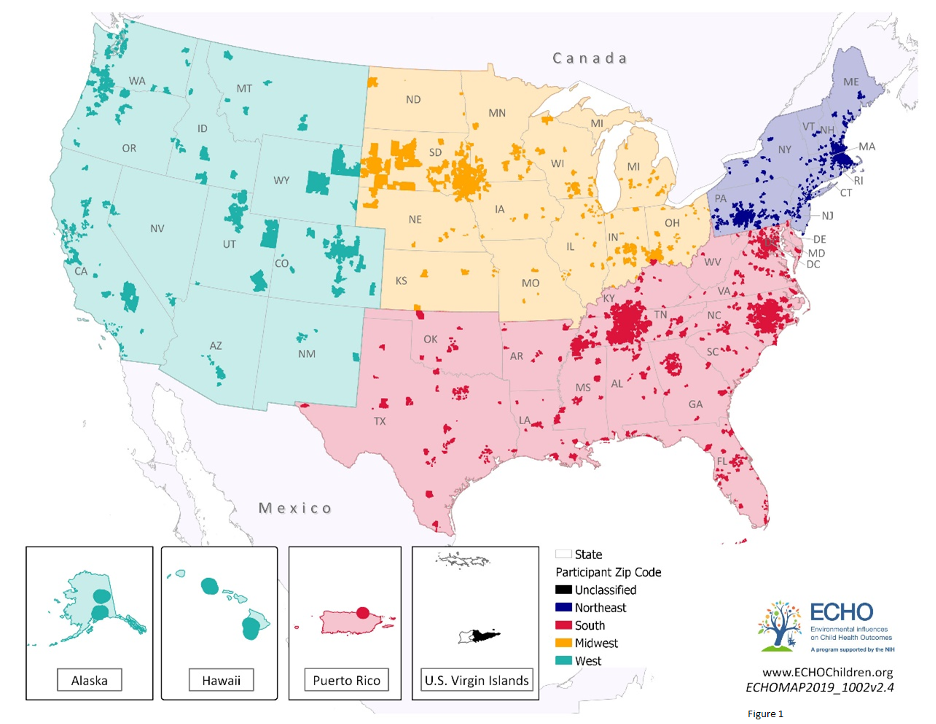
This image shows the different regions of the Unites States where study participants lived.

About 35% of US children are overweight or obese, increasing their lifetime risk for a variety of negative physical and mental health outcomes. Understanding which environmental, social, and cultural factors contribute to childhood obesity can help doctors and policymakers design strategies for early intervention. ECHO researchers Traci Bekelman, PhD, MPH and Dana Dabelea, MD, PhD of the University of Colorado Anschutz; Jody Ganiban, PhD of George Washington University; and their team explored how regional and demographic factors impact children’s weight. Their research, titled “Regional and Sociodemographic Differences in Average BMI Among U.S. Children in the ECHO Program,” is published in Obesity.

During the study, the team analyzed weight and height data doctors collected between 2000 and 2018 from more than 14,000 children and teens from birth to age 15 located across the US in the West, South, Northeast, and Midwest regions. The data incorporated information from children of various racial and ethnic backgrounds, and approximately half of the children were girls. The team used this data to calculate each child’s body mass index (BMI), an approximate measure of body fat based on height and weight. The team then compared these values based on each child’s birth weight, race, ethnicity, sex, home address, and mother’s level of education.

The study found correlations between the children’s BMI and their location. For example, BMI was lowest in the South and West compared to the Northeast. When demographic differences were accounted for, children in the Midwest had higher BMIs compared to children in the Northeast. More work is needed to understand how regional variations in the price and accessibility of food, the opportunities for physical activity, and the school policies and programs impact childhood obesity risk.

The team also found that children who weighed more at birth and children who had less educated mothers had higher BMIs on average. In the Northeast, South, and Midwest, non-Hispanic Black children had higher BMIs than non-Hispanic white children. And in the South and West, BMI was higher on average for Hispanic white children compared to non-Hispanic white children. This research highlights the need for more thorough investigations into how systemic inequalities contribute to obesity risk in children.

“We were surprised that we only found racial and ethnic differences in BMI in some regions,” said Bekelman. “This finding and future studies could help researchers understand the causes of health disparities.” She also noted that the next step for this research is to investigate which specific regional factors and demographic disparities contribute to higher BMIs.

Read the research summary.