




 Collaborative ECHO research led by Aaron Kaat, PhD of Northwestern University, and Kristen Lyall, ScD of the AJ Drexel Autism Institute evaluates two different versions of the full 65-question Social Responsiveness Scale (SRS) for measuring autism-related traits in preschool and school-age children. This study compared the questions used on each version and developed a comparable scoring method for both forms. Then, the researchers used computer-adaptive testing, where a computer program tailors the questionnaire in real-time to each participant, and found that a median of 14 questions was sufficient to reach a reliable score. This research, titled “Modifying the Social Responsiveness Scale for Adaptive Administration,” is published in Quality of Life Research.
Prior research has developed and examined shortened versions of the SRS questionnaire, but researchers haven’t been able to evaluate the reliability of these questionnaires for capturing broader traits in the general population or for preschool-age participants. This study included over 7,000 children ages 2.5-18 years old, most of whom did not have an autism diagnosis. The researchers conducted several analyses to assess a variety of factors that may affect how the full SRS and shortened versions of the SRS are scored. They were then able to use these data to simulate how computer-adaptive testing would score each individual after completing the minimum number of questions required to reach a comparable result.
“The results of this study suggest opportunities to reduce the amount of time participants need to spend completing questionnaires like the SRS,” said Dr. Lyall. “These results also suggest computer-adaptive questionnaires can be used to collect information in a way that is comparable to standard paper-based questionnaires, offering additional flexibility.”
The researchers are continuing to evaluate the computerized version of the SRS questionnaire developed in this study, comparing it to other versions of the questionnaire. Future research is needed to examine how these different questionnaires perform in different groups of people, and if results differ when captured according to self vs. parent report.
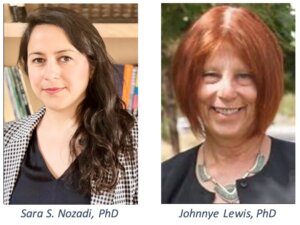 Collaborative ECHO research led by Sara Nozadi, PhD and Johnnye Lewis, PhD of the University of New Mexico, investigates whether the negative developmental effects observed in school-aged children over the course of the pandemic could also be seen in infants and toddlers. In this study, up to 15% of infants and toddlers who were developmentally on track prior to the COVID-19 pandemic showed signs of developmental delays during the pandemic. Male children showed more delays than female children, and language domain was the most affected developmental area. Additionally, families from minority communities and those with lower socioeconomic status were more likely to experience pandemic-related hardships. However, financial and social pandemic-related hardships were not associated with the individual changes observed in children’s developmental progress. This research, titled “Effects of COVID-19 financial and social hardships on infants’ and toddlers’ development in the ECHO program,” is published in
 Collaborative ECHO research led by Catherine Bulka, PhD, of the University of South Florida, and Rebecca Fry, PhD, of the University of North Carolina at Chapel Hill, investigates whether gene activity in the placenta might differ base on the infant’s sex. The results of this study suggest that the placentas of males and females might develop differently. This research, titled “Sex-based differences in placental DNA methylation profiles related to gestational age: an NIH ECHO meta-analysis,” is published in
  In a study investigating how per- and polyfluoroalkyl substances (PFAS) exposures affected pregnant mothers and their babies, ECHO researchers Amy Padula, PhD, MSc, and Tracey Woodruff, PhD, MPH, from the University of California, San Francisco found that higher levels of prenatal exposure to PFAS are associated with lower birthweights. The PFAS were detected in all participating mothers, suggesting some level of PFAS exposure from the environment.
 Collaborative ECHO research led by Alison Hipwell, PhD, ClinPsyD, of the University of Pittsburg, and Irene Tung, PhD, of California State University Dominguez Hills, found that being pregnant during the COVID-19 pandemic was associated with higher levels of stress and depression symptoms. The researchers found that participants who reported more emotional support and engaged in physical activity before and during the pandemic had less stress and fewer symptoms of depression. The results also showed that pregnancies during the pandemic were slightly shorter on average but there was no impact on infant birth weight. This study highlights the importance of providing access to emotional support and mental health care during pregnancy and identifying ways to promote physical activity to help improve maternal health and well-being, regardless of external conditions like the pandemic. This research, titled “Impact of Sedentary Behavior and Emotional Support on Prenatal Psychological Distress and Birth Outcomes During the COVID-19 Pandemic,” is published in
  Collaborative ECHO research led by Marie Camerota, PhD of the Warren Alpert Medical School of Brown University, investigates the link between newborns’ behavior patterns with their mothers’ demographic characteristics and health during pregnancy. The study looked at over 1,000 newborns and their mothers from across the U.S., and found that male babies, babies from younger mothers, and babies whose mothers were depressed or used tobacco during pregnancy were the most likely to have poorly regulated behavior shortly after birth. Babies with poorly regulated behavior were identified as hyper-aroused (i.e., too excitable) or hypo-aroused (i.e., slow to respond). This research, titled “Prenatal and perinatal factors associated with neonatal neurobehavioral profiles in the ECHO Program,” is published in
  Collaborative ECHO research led by Carrie Breton, ScD, MPH of the University of Southern California and Christine Ladd-Acosta, PhD of Johns Hopkins University found that preeclampsia and gestational diabetes may be linked to slower biological development in infants. The researchers found that newborns who were exposed to these pregnancy complications were biologically younger than those without exposure—an effect that was most noticeable in female infants. The results of this study provide an important clue about how biological mechanisms in offspring might be affected by common pregnancy complications and how these conditions could be linked to child health outcomes. This research, titled “Analysis of Pregnancy Complications and Epigenetic Gestational Age of Newborns,” is published in
 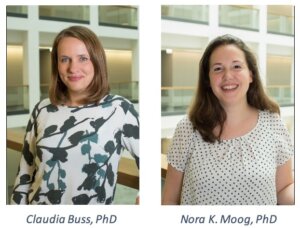 Collaborative ECHO research led by Claudia Buss, PhD of the University of California, Irvine and Charité – Universitätsmedizin Berlin and Nora K. Moog, PhD of Charité – Universitätsmedizin Berlin, suggests that maternal history of childhood maltreatment may increase the risk for multiple child health outcomes, including asthma, depressive symptoms, attention-deficit/hyperactivity disorder (ADHD), and autism spectrum disorder (ASD). The results of this study also indicate that children of mothers who experienced neglect or abuse as children were more likely to develop several of these health outcomes simultaneously. This research, titled “Intergenerational transmission of the consequences of maternal exposure to childhood maltreatment – a United States nationwide observational study of multiple cohorts in the ECHO program,” is published in