





Collaborative ECHO research led by Maristella Lucchini, PhD of Columbia University Irving Medical Center investigates changes in childhood sleep behaviors during the COVID-19 pandemic. The researchers looked at data from 528 children across the United States and found that, during the COVID-19 pandemic, children went to bed later, woke up later, and took longer to fall asleep, but their overall time spent asleep did not change. The study also found that children in minority communities went to bed later, slept less, and took naps more frequently. This research, titled “Impact of the COVID-19 pandemic on children’s sleep habits: an ECHO study,” is published in Pediatric Research.
This study included children aged 4 to 12 from 14 ECHO cohorts across the United States. The ECHO Program’s Sleep Health of Children and Adolescents Questionnaire was used to evaluate children’s sleep habits before the pandemic began and at two time periods during the pandemic. The researchers also collected sociodemographic information from self-reports and medical records.
ECHO researchers found significant changes in children’s sleep habits, as well as differences in children’s sleep behaviors between racial/ethnic groups. However, parental knowledge of the importance of sleep might have contributed to children sleep health. Interviews with 38 participant caregivers revealed they prioritized routines to maintain their children’s amount of sleep but were generally more flexible about bedtimes.
“This is the first study investigating changes in childhood sleep habits in the United States during the COVID-19 pandemic using data collected before and during the pandemic,” said Dr. Lucchini. “The results highlight potential targets for future interventions and support the need to examine and address the root causes of racial and ethnic sleep disparities in childhood.”
Using data from the same cohort of children, ECHO researchers are in the process of analyzing and publishing results on changes in diet, physical activity, and screen time during the COVID-19 pandemic.
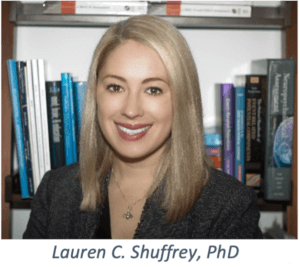 Collaborative ECHO research led by Lauren C. Shuffrey, PhD of Columbia University examines the effects of gestational diabetes, a type of diabetes that develops during pregnancy, and prenatal depression on a person’s risk for developing postpartum depression. The study found that people with gestational diabetes were more likely to be classified as having prenatal depression. Those with both gestational diabetes and prenatal depression were at an increased risk for postpartum depression. But gestational diabetes on its own, without prenatal depression, was not associated with increased risk for postpartum depression.
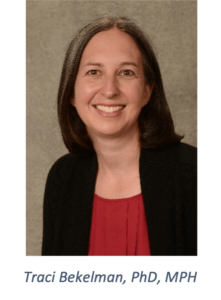 Collaborative ECHO research led by Traci Bekelman, PhD, MPH of the University of Colorado, Anschutz Medical Campus investigates how the COVID-19 pandemic affected children’s diet, physical activity, screen time, and sleep. The study found that children’s screen time increased significantly during the pandemic with Hispanic children and non-Hispanic Black children having the most noticeable increase in screen time. The amount of time children spent asleep also increased, but only among children whose sleep time was below the recommended range before the pandemic. The study didn’t find any significant increase in the amounts of sugary drinks and unhealthy snack foods children consumed in the full study sample, but it did find a more noticeable increase among Hispanic children and older children.
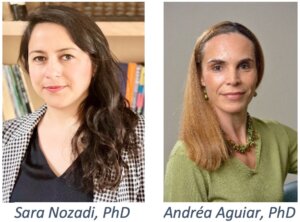 Collaborative ECHO research led by Sara Nozadi, PhD, of the University of New Mexico and Andréa Aguiar, PhD of the University of Illinois Urbana-Champaign suggests that eye-tracking technology can be used as a robust measure across diverse populations and settings to assess attention patterns linked to socially withdrawn behavior in preschool children. Their research, titled “Cross-Cultural Applicability of Eye-Tracking in Assessing Attention to Emotional Faces in Preschool-Aged Children” is published in the
  Collaborative ECHO research led by Giehae Choi, PhD and Jessie Buckley, PhD, both of Johns Hopkins University, along with Tracey Woodruff, PhD, MPH of the University of California, San Francisco, investigates whether pregnant women are exposed to potentially dangerous chemicals commonly found in a variety of household products, including plastics, disinfectants, and products that contain dyes or pigments. Two of these chemicals, melamine and cyanuric acid, were found in over 99% of study participants, and exposure to four different types of aromatic amines were also found in nearly all participants. Levels of these chemicals were higher among participants of color and those exposed to tobacco smoke. This research, titled “Exposure to melamine and its derivatives and aromatic amines among pregnant women in the United States: The ECHO Program,” is published in
  A recent review paper authored by Michael O’Shea, MD of the University of North Carolina at Chapel Hill, Monica McGrath, PhD of Johns Hopkins University, and Judy Aschner, MD of Hackensack University, and Barry Lester, PhD of Brown University’s Alpert Medical School provides an overview of the collaborative work ECHO has been doing to study and collect data on the effects of premature birth on child health outcomes. The article describes ECHO cohorts that have enrolled premature infants (born before 32 weeks of gestation) between April 2002 and March 2020, including three ECHO cohorts that are almost exclusively comprised of preterm infants. Researchers can use ECHO data to investigate the relationship between preterm birth, environmental exposures, and childhood chronic and developmental health conditions. This research, titled “Environmental influences on Child Health Outcomes: Cohorts of Individuals Born Very Preterm,” is published in
  Collaborative ECHO research led by Emily Knapp, PhD and Aruna Chandran, MD of Johns Hopkins Bloomberg School of Public Health investigates the effects of the COVID-19 pandemic on children’s body mass index (BMI), an estimation of overall body fat. The study looked at the BMI of 1,966 children ages 2 through 18 years old from 38 ECHO cohorts across the United States during the COVID-19 pandemic. The results of this study suggest that, on average, children gained weight at a higher rate during the pandemic. This research, titled “Changes in BMI during the COVID-19 Pandemic,” is published in
 Collaborative ECHO research led by Sheena Martenies, PhD, MPH of the University of Illinois at Urbana-Champaign investigates the combined effects of environmental hazards and social stressors on pregnancy and infant health. This research included information on more than 13,000 infants born between 2010 and 2019 from 41 ECHO cohorts located throughout the United States. In this study, researchers found that pregnant women living in neighborhoods with higher combined exposures had shorter pregnancies and smaller babies. This research, titled “Associations between combined exposure to environmental hazards and social stressors at the neighborhood level and individual perinatal outcomes in the ECHO-wide cohort,” is published in