




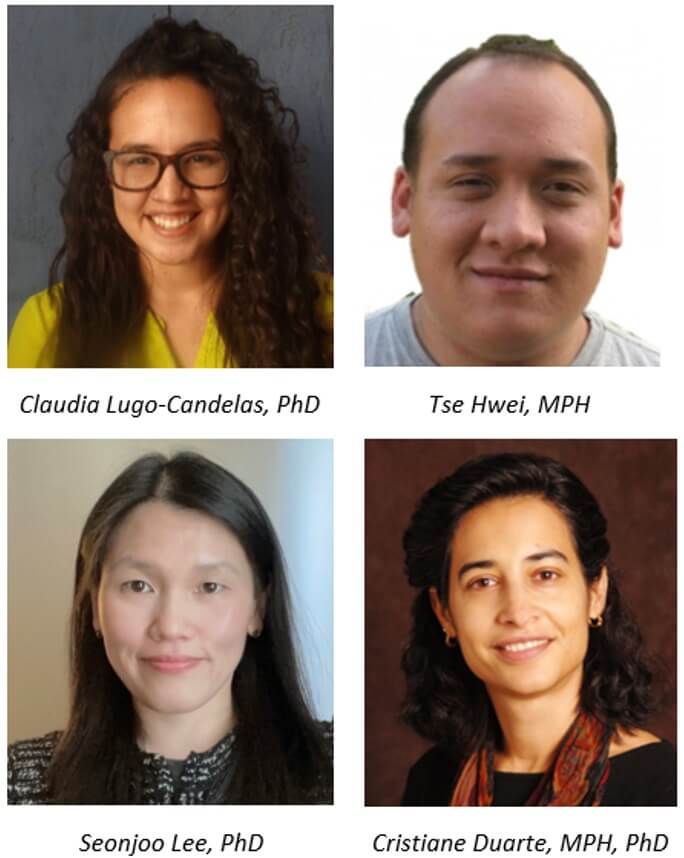
 Collaborative ECHO research led by Claudia Lugo-Candelas, PhD, Tse Hwei, MPH, Seonjoo Lee, PhD, and Cristiane Duarte, MPH, PhD of the Columbia University Irving Medical Center and New York State Psychiatric Institutes investigates the effect of prenatal sleep on children’s health outcomes, including neurodevelopment disorders and sleep quality. This research, titled “Prenatal sleep health and risk of offspring ADHD symptomatology and associated phenotypes: A prospective analysis of timing and sex differences in the ECHO Cohort,” is published in The Lancet Regional Health – Americas.
Sleep difficulties are common in pregnancy. Poor prenatal sleep may relate to negative outcomes for both parent and child, including pregnancy complications and certain birth outcomes. The impact of poor prenatal sleep may also extend beyond pregnancy and birth and may increase the risk for neurodevelopment disorders in offspring, particularly attention-deficit/hyperactivity disorder (ADHD).
In this study, ECHO researchers aimed to study potential associations between poor prenatal sleep and an increased risk of ADHD symptoms and sleep problems in offspring. The research team used data from 794 mother-child pairs across five ECHO research sites and all enrolled pairs with available prenatal sleep and offspring ADHD assessments before age 7 were included. The pregnant participants reported on their sleep during pregnancy using self-report questionnaires and reported on children’s symptoms and behaviors when children were between 3 and 5 years old. The study assessed the children’s ADHD symptoms and associated characteristics using the Child Behavior Checklist Preschool Version, a widely used parent report that measures behavior problems in children.
The study found that prenatal sleep quality and duration, particularly in the second trimester, appeared related to children’s risk for ADHD, emotional reactivity, and sleep problems at age 4. Longer sleep duration in the second trimester was associated with fewer ADHD symptoms in children. Poorer sleep quality scores in the second trimester were associated with greater offspring ADHD symptomatology. Shorter duration and poorer quality of sleep during the second trimester were also associated with more sleep difficulties in children.
“This study extends prior work by examining the associations between self-reported prenatal maternal sleep health and offspring ADHD symptoms in early childhood in a large, socio-demographically diverse sample,” Dr. Lugo-Candelas said. “This study was also the first looking to understand if sleep at a particular time in pregnancy is specifically related to offspring outcomes. Our research suggests we need to better study the role of sleep in pregnancy on both the health of the pregnant woman and their offspring to understand these potential associations.”
Future studies are needed to replicate these findings, as well as investigate the possible mechanisms. Poor sleep may impact inflammation in pregnancy and offspring development, but studies have not examined that association.
 Collaborative ECHO research led by Yury Bochkov, PhD and James Gern, PhD of the University of Wisconsin at Madison investigates similarities and differences in the immune responses to two types of rhinovirus—RV-A and RV-C. This research, titled “Rhinoviruses A and C elicit long-lasting antibody responses with limited cross-neutralization,” is published in the
  Collaborative ECHO research led by Elissa Faro, PhD, of the University of Iowa, investigates what factors contribute to the success of large, multi-site research programs, like ECHO. The research team interviewed 24 ECHO investigators and staff, and found that communication and working as a team were important for successful collaboration. Most interviewees expressed a desire for more opportunities for direct connection, learning, and sharing with their colleagues. Overall, respondents felt the ECHO Program excels at conducting solution-oriented, high-impact child health research, but also that the Program has an opportunity to further improve communication, collaboration, and decision-making across its vast network of sites and components. This research, titled “A Mixed-Methods Analysis to Understand the Implementation of a Multi-stakeholder Research Consortium: Environmental influences on Child Health Outcomes (ECHO),” is published in the
  Collaborative ECHO research led by Fang Fang, PhD, of the Genomics and Translational Research Center of RTI International evaluates multiple epigenetic clocks to test their accuracy when used to predict the biological age of children. This research, titled “Evaluation of Pediatric Epigenetic Clocks Across Multiple Tissues,” is published in

 Collaborative ECHO Cohort research led by Shuting Zheng, PhD, of the University of California, San Francisco, Maxwell Mansolf, PhD, of Northwestern University, and Somer Bishop, PhD, of the University of California, San Francisco suggests that scores from a commonly used measure of behavior problems in young children may be skewed depending on the primary language, education, and sex of the caregiver who fills out the survey. This research, titled “Measurement Bias in Caregiver-Report of Early Childhood Behavior Problems across Demographic Factors in an ECHO-wide Diverse Sample,” is published in the
  I take great pleasure in sharing that the ECHO Cohort Consortium entered a new cycle at the beginning of September, which will allow the ECHO Program to extend and expand the ECHO Cohort to fulfill its mission of enhancing child health for generations to come. We look forward to continuing the high-impact research coming out of ECHO over the next seven years.