



ECHO Study Finds Associations Between Neighborhood Social Vulnerability at Birth With Higher Childhood Body Mass Index

<< Back to Research Summaries

ECHO Study Finds Associations Between Neighborhood Social Vulnerability at Birth With Higher Childhood Body Mass Index

Author(s): Izzuddin M. Aris, et al.


Who sponsored this study?

The Environmental influences on Child Health Outcomes (ECHO) Program, Office of The Director, National Institutes of Health supported this research.


What were the study results?

The study found that children who lived in higher opportunity or less vulnerable neighborhoods early in life had lower average BMI and lower risk of obesity from childhood to adolescence. The neighborhoods children lived in at birth affected these health outcomes more than the neighborhoods they lived in later in childhood. These associations were not affected by individual and family sociodemographics or by prenatal risk factors for childhood obesity.

Footnote: Results reported here are for a single study. Other or future studies may provide new information or different results. You should not make changes to your health without first consulting your healthcare professional.


What was the study's impact?

This research focuses on how community resources can enhance children’s health outcomes. The Child Opportunity Index, Social Vulnerability Index, and other measures of neighborhood characteristics could help inform efforts to reduce neighborhood barriers and improve access to community resources so families can better support their children’s health and well-being.


Why was this study needed?

The physical and social characteristics of neighborhoods may influence how children grow and develop. Children’s body mass index (BMI)—an estimation of their overall body fat—and childhood obesity are significant risk factors for heart disease later in life. The associations between neighborhood characteristics and children’s BMI and risk of obesity remains understudied. This study compared neighborhood-level measures of opportunity and social vulnerability with BMI and obesity patterns in children from birth to adolescence.


Who was involved?

This study included 20,677 children from 54 ECHO cohorts located across the United States.


What happened during the study?

ECHO researchers collected each child’s home address and weight at birth, infancy (6 months‒1.5 years), early childhood (2‒5 years), and mid-childhood (5‒10 years). The researchers linked participants’ addresses throughout childhood to data from the Child Opportunity Index and Social Vulnerability Index. The Child Opportunity Index measures neighborhood conditions and resources that may affect child health outcomes including education, health and environment, and social and economic factors. The Social Vulnerability Index identifies communities with high numbers of public health emergencies and other stressors by looking at demographics, socioeconomic status, type of housing, access to transportation, and other factors.

The researchers used these data to examine links between children’s neighborhood-level opportunity and social vulnerability and their BMI and obesity over time.


What happens next?

More research is needed to determine how changes to specific aspects of neighborhood environments might influence weight gain and obesity in children.


Where can I learn more?

Access the full journal article, titled “Associations of Neighborhood Opportunity and Vulnerability with Trajectories of Child Body Mass Index and Obesity Among U.S. Children,” in JAMA Network Open.


The content is the responsibility of the authors and does not necessarily represent the official views of the National Institutes of Health.


Published: December 22, 2022


Access the associated article.

ECHO Researchers Investigate Child Weight Gain During the COVID-19 Pandemic

Collaborative ECHO research led by Emily Knapp, PhD and Aruna Chandran, MD of Johns Hopkins Bloomberg School of Public Health investigates the effects of the COVID-19 pandemic on children’s body mass index (BMI), an estimation of overall body fat. The study looked at the BMI of 1,966 children ages 2 through 18 years old from 38 ECHO cohorts across the United States during the COVID-19 pandemic. The results of this study suggest that, on average, children gained weight at a higher rate during the pandemic. This research, titled “Changes in BMI during the COVID-19 Pandemic,” is published in Pediatrics.
Childhood obesity is a serious health condition that can affect long-term health and quality of life. At the start of the COVID-19 pandemic, there was concern among researchers and doctors that the closure of schools and the cancellation of recreation and sport activities would cause an increase in childhood obesity.

To understand the pandemic’s impact on children’s weight, researchers analyzed yearly changes in children’s body mass index (BMI) before and during the pandemic, considering each child’s age and sex. The researchers also investigated whether changes in BMI were different across specific sociodemographic traits including race, ethnicity, pre-pandemic BMI, and household income.

The results of this study indicated that on average children gained weight at an increased rate during the pandemic, and children who had obesity before the pandemic gained weight at a faster rate compared to children who were at a healthy weight pre-pandemic. Additionally, children in higher income households were at a lower risk of excess BMI gain during the pandemic.

“This study highlights the need for interventions to mitigate the physical and mental health consequences of the COVID-19 pandemic,” said Dr. Knapp. “The conditions faced by families during the COVID-19 pandemic may have led to an acceleration of weight gain in children. This study highlights the need to support less resourced families, who have borne the worst consequences of the pandemic.”

Future studies can explore strategies to help families and communities thrive amidst the challenges faced during the ongoing COVID-19 pandemic. As the pandemic continues to alter children’s lives, it will be important to monitor changes in health outcomes among children and use these data to build programs to reduce health inequities.

Read the research summary.

ECHO Publication Investigates Regional and Demographic Variations in Children’s Body Mass Index

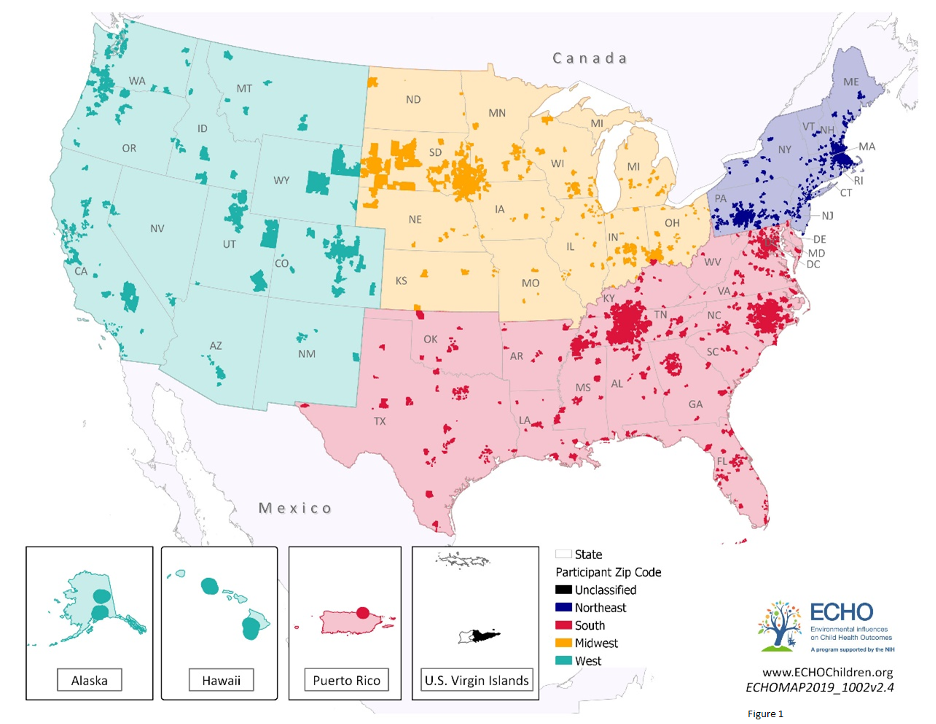
This image shows the different regions of the Unites States where study participants lived.

About 35% of US children are overweight or obese, increasing their lifetime risk for a variety of negative physical and mental health outcomes. Understanding which environmental, social, and cultural factors contribute to childhood obesity can help doctors and policymakers design strategies for early intervention. ECHO researchers Traci Bekelman, PhD, MPH and Dana Dabelea, MD, PhD of the University of Colorado Anschutz; Jody Ganiban, PhD of George Washington University; and their team explored how regional and demographic factors impact children’s weight. Their research, titled “Regional and Sociodemographic Differences in Average BMI Among U.S. Children in the ECHO Program,” is published in Obesity.

During the study, the team analyzed weight and height data doctors collected between 2000 and 2018 from more than 14,000 children and teens from birth to age 15 located across the US in the West, South, Northeast, and Midwest regions. The data incorporated information from children of various racial and ethnic backgrounds, and approximately half of the children were girls. The team used this data to calculate each child’s body mass index (BMI), an approximate measure of body fat based on height and weight. The team then compared these values based on each child’s birth weight, race, ethnicity, sex, home address, and mother’s level of education.

The study found correlations between the children’s BMI and their location. For example, BMI was lowest in the South and West compared to the Northeast. When demographic differences were accounted for, children in the Midwest had higher BMIs compared to children in the Northeast. More work is needed to understand how regional variations in the price and accessibility of food, the opportunities for physical activity, and the school policies and programs impact childhood obesity risk.

The team also found that children who weighed more at birth and children who had less educated mothers had higher BMIs on average. In the Northeast, South, and Midwest, non-Hispanic Black children had higher BMIs than non-Hispanic white children. And in the South and West, BMI was higher on average for Hispanic white children compared to non-Hispanic white children. This research highlights the need for more thorough investigations into how systemic inequalities contribute to obesity risk in children.

“We were surprised that we only found racial and ethnic differences in BMI in some regions,” said Bekelman. “This finding and future studies could help researchers understand the causes of health disparities.” She also noted that the next step for this research is to investigate which specific regional factors and demographic disparities contribute to higher BMIs.

Read the research summary.

Nationwide ECHO Study Suggests Children in the Western and Southern U.S. May Have Lower Body Mass Index Than Children in the Northeast

<< Back to Research Summaries

Nationwide ECHO Study Suggests Children in the Western and Southern U.S. May Have Lower Body Mass Index Than Children in the Northeast

Author(s): Dana Dabelea, Jody Ganiban, Traci Bekelman, et al.


Who sponsored this study?

This research was supported by the Environmental influences on Child Health Outcomes (ECHO) program, Office of The Director, National Institutes of Health.


What were the study results?

BMI was lowest for children in the West and South compared to those in the Northeast. When demographic differences were accounted for, children in the Midwest had higher BMIs than those in the Northeast. Across all regions, BMI was highest in children who weighed more at birth and children with less educated mothers. In the Northeast, South, and Midwest, non-Hispanic Black children had higher BMIs on average compared to non-Hispanic white children. In the South and West, BMI was higher for Hispanic white children compared to non-Hispanic white children.


What was the study's impact?

This study revealed some of the regional and demographic factors influencing childhood obesity and overweight. The regional differences in children’s BMI suggest that their surroundings, cultures, and relationships affect the development of childhood obesity. These differences could potentially be linked to variations in food prices, fast food options, and opportunities to exercise.


Why was this study needed?

About 35% of US children are overweight or obese. Childhood obesity can have serious physical and mental health effects that can follow children into adulthood. Understanding the factors that affect children’s weight, can help us create ways to prevent obesity. This study looked at factors related to children’s weight where children live, how much they weighed at birth, and their ethnic background.


Who was involved?

This study included more than 14,000 children and teenagers from birth to age 15. The children lived in the West, South, Northeast, and Midwest regions of the United States. The study included children from different racial and ethnic backgrounds. About half of the children were girls.


Figure 1 This image shows the different regions of the Unites States where study participants lived.


What happened during the study?

Doctors measured children’s height and weight from 2000-2018. The research team used this information to calculate each child’s body mass index (BMI), which is an approximate measure of body fat based on height and weight. The team compared differences in average BMI based on region, mother’s level of education, and demographic factors, including birth weight, race, ethnicity, and sex.


What happens next?

More research is needed to understand exactly how regional environments and policies impact children’s BMI and how local policies contribute to differences in obesity risk based on demographics. Identifying the regional and social factors that result in increased obesity risk can help policymakers and public health officials create ways to prevent obesity.


Where can I learn more?

Access the full journal article, titled “Regional and Sociodemographic Differences in Average BMI Among U.S. Children in the ECHO Program” in Obesity.

The content is the responsibility of the authors and does not necessarily represent the official views of the National Institutes of Health.


Published: August 31, 2021


Access the associated article.

read more summaries here:

Which Children Develop Asthma in the US

Author(s): Christine Cole Johnson and Aruna Chandran

How Environmental Exposures Affect Child Health Across Multiple Generations

Author(s): Carrie Breton, Rebecca Fry, Alison Hipwell, Cristiane Duarte, Linda Kahn, and Joseph Braun