ECHO Study Suggests Limiting Sugar-Sweetened Beverages in Home Key to Reduce Total Consumption by Children

<< Back to Research Summaries

ECHO Study Suggests Limiting Sugar-Sweetened Beverages in Home Key to Reduce Total Consumption by Children

Authors: Matt Kasman, et al


Who sponsored this study?

The Environmental influences on Child Health Outcomes (ECHO) Program, Office of The Director, National Institutes of Health supported this research.


Why was this study needed?

Health experts agree that sugar-sweetened drink consumption by children in the U.S.  should be reduced but finding effective strategies has been a challenge. Large-scale interventions are costly and have shown limited effects. Computer modeling to explore what drives consumption in specific populations could lead to tailored strategies that yield better results.


What were the study results?

Through a computer simulation based on data collected over several years from thousands of real children, researchers found that limiting access to sugary drinks in the home could reduce childhood consumption by as much as 87%. Reducing sugar-sweetened drink availability at school and childcare facilities was also helpful. The amount of the reductions also varied between the groups of children simulated.

Footnote: Results reported here are for a single study. Other or future studies may provide new information or different results. You should always consult with a qualified healthcare provider for diagnosis and for answers to your personal questions.


What was the study's impact?

This study highlights the importance of tailoring interventions to reduce sugar-sweetened drink consumption for different populations. Using computer models, researchers may gain more information about populations that can help to identify effective targeted interventions.


Who was involved?

This study examined data from children ages 2 to 7 years old in three ECHO research sites across the U.S. These children spent time in different environments as they grew—home, childcare, and school—where they had varying access to sugary beverages.


What happened during the study?

Researchers entered data based on children from three ECHO research sites into a computer model to recreate their sugar-sweetened beverage consumption.  Based on the computer model, researchers simulated potential interventions and measured their impact on reducing consumption in different populations. Computer models can be affected by certain factors, including socioeconomic status, BMI, time spent in a specific setting, accessible beverages in the home, and access to a pediatrician.


What happens next?

In future studies, researchers plan to include older children and adjust computer models to explore the consumption of other foods and beverages with health implications.


Where can I learn more?

Access the full journal article, titled “Childhood Sugar-sweetened Beverage Consumption: An Agent-based Model of Context-specific Reduction Efforts,” in the American Journal of Preventive Medicine.

A summary of a previous study that applied computational modeling to a single ECHO research site can be found here.


The content is the responsibility of the authors and does not necessarily represent the official views of the National Institutes of Health.

Published July 13, 2023


Access the associated article.

Maternal PFAS Exposure During Pregnancy Increases Children’s Risk of Obesity

<< Back to Research Summaries

Maternal PFAS Exposure During Pregnancy May Increase Children’s Risk of Obesity

Authors: Yun Liu, Joseph Braun, et al.


Who sponsored this study?

This research was supported by the Environmental influences on Child Health Outcomes (ECHO) Program, Office of The Director, National Institutes of Health.


Why was this study needed?

Per- and polyfluoroalkyl substances (PFAS) are long-lasting chemicals that can be found in many household materials, as well as food and drinking water. Maternal PFAS exposure during pregnancy may be linked to increased weight and a higher risk of obesity among children and adolescents. However, existing studies looking at these associations have had inconsistent findings.


What were the study results?

The study found that higher levels of some PFAS were linked with slightly higher BMIs in children and an increased risk of obesity. This trend was seen across male and female children and wasn’t affected by the presence of other factors linked to childhood obesity.

Footnote: Results reported here are for a single study. Other or future studies may provide new information or different results. You should not make changes to your health without first consulting your healthcare professional.


What was this study's impact?

Recently, there has been growing interest in understanding the effects of PFAS exposure on children’s health and establishing policies to address PFAS pollution. The US Environmental Protection Agency (EPA) has created a Roadmap to address PFAS contamination. Studies like this one can help better understand the risks of PFAS to take effective actions to protect vulnerable populations.


Who was involved?

The researchers used data from 1,391 children between the ages of 2 and 5 years and their mothers who were enrolled in eight ECHO cohorts across United States from 1999 to 2019.


What happened during the study?

The researchers measured levels of seven different PFAS in maternal blood samples collected during pregnancy. The researchers also used data on children’s weight and height to calculate each child’s body mass index (BMI), an approximate measure of body fat.


What happens next?

Future studies are needed to examine potential links between maternal PFAS exposure during pregnancy and obesity-related health concerns in older children.


Where can I learn more?

Access the full journal article, titled “Associations of Gestational Perfluoroalkyl Substances Exposure with Early Childhood BMI Z-Scores and Risk of Overweight/Obesity: Results from the ECHO Cohorts,” in Environmental Health Perspectives.


The content is the responsibility of the authors and does not necessarily represent the official views of the National Institutes of Health.

Published June 7, 2023

Access the associated article.

See ECHO's PFAS research.

Read More Research Summaries about Chemical Exposures and Pregnancy

Effect of Prenatal PFAS Exposure on Birthweight

Authors: Amy Padula, Tracey Woodruff, et al.

Does prenatal PFAS exposure affect a child’s risk for developing autism-related traits?

Authors: Jennifer Ames, Ghassan Hamra, et al.

Exposures to environmental chemicals and their effect on important molecules during pregnancy

Author(s): Brett T. Doherty, Megan E. Romano, et al.

Do chemicals that break down slowly in the environment affect how long it takes to become pregnant?  

Author(s): Linda Kahn, Alison Hipwell, Kim Harley, Pam Factor-Litvak, Michele Klein-Fedyshin, Christine Porucznik, Eva Siegel, Yeyi Zhu

A review of studies that look at whether exposure to common non-persistent chemicals in consumer products delays the time it takes to become pregnant

Author(s): Alison E. Hipwell, Linda G. Kahn, Pam Factor-Litvak, et al

ECHO Study Links Maternal Health Factors With Newborn Metabolism and Child Body Mass Index

<< Back to Research Summaries

ECHO Study Links Maternal Health Factors With Newborn Metabolism and Child Body Mass Index

Authors: Britt Snyder, Tina Hartert, James Gern, et al.


Who sponsored this study?

The Environmental influences on Child Health Outcomes (ECHO) Program, Office of the Director, National Institutes of Health supported this research.


Why was this study needed?

Few studies have looked at possible links between maternal health characteristics, including environmental stressors, and the metabolism of newborns. Metabolism refers to chemical reactions that take place within the cells to provide the body with the energy needed for growth and maintaining health. Researchers often study metabolism by measuring the blood levels of certain molecules—called metabolites—that are created during those chemical processes.

This study expanded previous findings that showed links between maternal characteristics (such as pre-pregnancy smoking, pre-pregnancy body mass index, education, occupation status, marital status, age at delivery, asthma diagnosis, diabetes during pregnancy, or type of delivery) and amounts of metabolites in newborns. The study also explored the link between these metabolites and child growth patterns. In addition, this study explores the maternal factors and potential series of chemical changes in utero (in the womb) that may contribute to the link between newborn metabolism and childhood BMI*.

*Body Mass Index (BMI) is a common health screening tool that considers both height and weight.


What were the study results?

The researchers identified links between maternal health characteristics and the concentration of various metabolites in newborns. Additionally, this study showed that some metabolites were also linked to childhood BMI at ages 1–3 years.

The study found that factors like higher BMI before pregnancy or maternal age at delivery seemed to increase the levels of key metabolites in newborns. However, other metabolites which were linked with maternal health characteristics were not associated with changes in childhood BMI.


What was the study's impact?

Previous research has shown associations between levels of some newborn metabolites and childhood growth, overweight, and obesity. This study provides additional insights on the maternal factors and potential in utero pathways connecting newborn metabolism and later metabolic dysfunction in children. Such imbalance may increase a person’s lifetime risk of coronary heart diseasediabetesstroke, and other serious health problems.


Who was involved?

This study included 3,492 infants enrolled in three ECHO research sites with linked newborn screening metabolic data.


What happened during the study?

The researchers used data on maternal health characteristics collected from questionnaires, birth certificates, and medical records. Child BMI was obtained from medical records and study visits. The researchers used statistical tools to evaluate possible links between maternal health characteristics and newborn metabolism.

Footnote: Results reported here are for a single study. Other or future studies may provide new information or different results. You should not make changes to your health without first consulting your healthcare professional.


What happens next?

This study is an early step in assessing biological pathways through which maternal health characteristics may influence prenatal metabolic development. These metabolic changes may then influence health after birth. Future studies are needed to further explore the potential pathways through which maternal health characteristics may impact child health.


Where can I learn more?

Access the full journal article, titled “The Associations of Maternal Health Characteristics, Newborn Metabolite Concentrations, and Child Body Mass Index among US Children in the ECHO Program,” in Metabolites.


The content is the responsibility of the authors and does not necessarily represent the official views of the National Institutes of Health.


Published April 1, 2023


Access the associated article.

Child Body Mass Index Dropped After Healthy, Hunger-Free Kids Act in Schools

<< Back to Research Summaries

Child Body Mass Index Dropped After Healthy, Hunger-Free Kids Act in Schools

Author(s): Aruna Chandran, Emily Knapp, et al.


Who sponsored this study?

This research was supported by the Environmental influences on Child Health Outcomes (ECHO) Program, Office of The Director, National Institutes of Health.


What were the study results?

The study showed an overall decrease in BMI in the first few years following the implementation of the HHFKA compared to BMI in the decade prior to the program. Among children ages 12-18 years, who may have more autonomy in purchasing their own lunches or snacks during the school day, BMI decreased from year to year following the start of the HHFKA. This was a reversal of the trends seen during the decade before the program, during which adolescent BMI was increasing each year. This study also supported findings from previous studies that found the HHFKA had a positive effect on the health of children from lower-income families by contributing to an annual decrease in their BMI.

Footnote: Results reported here are for a single study. Other or future studies may provide new information or different results. You should not make changes to your health without first consulting your healthcare professional.


What was the study's impact?

The National School Lunch Program and School Breakfast Program (NSLP) provides free or low cost meals to over 30 million children annually, providing an estimated 50% of students’ caloric intake each school day. This study found that the HHFKA was associated with decreases in child and adolescent BMI. Increasing BMI trends before the HHFKA was implemented were stopped or even reversed in several populations after the law was implemented, which could critically influence their long-term health. The study also found that the implementation of the HHFKA decreased BMI of children from lower-income families, who are more likely to participate in the NSLP and are at higher risk of obesity. Accessibility to school meals and snacks represents a key opportunity for intervention to combat the childhood obesity epidemic.


Why was this study needed?

Childhood obesity is a serious health concern with long-term consequences for health and quality of life. Nearly 1 in 5 children in America is obese. The 2010 Healthy, Hunger-Free Kids Act (HHFKA) was the first legislation passed in nearly 3 decades aimed at improving the nutritional quality of breakfast, lunch, and snacks sold at schools. Studies have shown that the HHFKA has improved the quality of school meals without affecting cost or program participation, but only a few small studies have explored whether the HHFKA reduced body mass index (BMI) in children over time.


Who was involved?

This study included 14,121 children from the ECHO Program between the ages of 5 and 18 who had at least one height and weight measurement recorded between January 2005 to March 2020.


What happened during the study?

Researchers used height and weight measurements from children across 50 ECHO cohorts to calculate each child’s BMI and adjusted each measurement based on age and sex. They used these data to evaluate yearly BMI trends from before and after the implementation of the Healthy, Hunger Free Kids Act in September 2016.


What happens next?

Future studies are needed to further explore and verify the effect of improving the nutritional quality of school meals on childhood obesity. In addition, policymakers could use data from studies like this to evaluate policies related to improving the nutritional quality of meals provided in schools.


Where can I learn more?

Access the full journal article, titled “Changes in Body Mass Index Among School-Aged Children Following Implementation of the Healthy, Hunger-Free Kids Act,” in JAMA Pediatrics.


The content is the responsibility of the authors and does not necessarily represent the official views of the National Institutes of Health.


Published: February 13, 2023


Access the associated article.

read more summaries here:

Changes in Body Mass Index (BMI) during the COVID-19 Pandemic

Authors: Emily Knapp, Aruna Chandran, et al.

Children’s body mass index: Does it vary by where children live and their individual characteristics?

Author(s): Dana Dabelea, et al.

How Environmental Exposures Affect Child Health Across Multiple Generations

Author(s): Carrie Breton, Rebecca Fry, Alison Hipwell, Cristiane Duarte, Linda Kahn, and Joseph Braun

ECHO Study Finds Associations Between Neighborhood Social Vulnerability at Birth With Higher Childhood Body Mass Index

<< Back to Research Summaries

ECHO Study Finds Associations Between Neighborhood Social Vulnerability at Birth With Higher Childhood Body Mass Index

Author(s): Izzuddin M. Aris, et al.


Who sponsored this study?

The Environmental influences on Child Health Outcomes (ECHO) Program, Office of The Director, National Institutes of Health supported this research.


What were the study results?

The study found that children who lived in higher opportunity or less vulnerable neighborhoods early in life had lower average BMI and lower risk of obesity from childhood to adolescence. The neighborhoods children lived in at birth affected these health outcomes more than the neighborhoods they lived in later in childhood. These associations were not affected by individual and family sociodemographics or by prenatal risk factors for childhood obesity.

Footnote: Results reported here are for a single study. Other or future studies may provide new information or different results. You should not make changes to your health without first consulting your healthcare professional.


What was the study's impact?

This research focuses on how community resources can enhance children’s health outcomes. The Child Opportunity Index, Social Vulnerability Index, and other measures of neighborhood characteristics could help inform efforts to reduce neighborhood barriers and improve access to community resources so families can better support their children’s health and well-being.


Why was this study needed?

The physical and social characteristics of neighborhoods may influence how children grow and develop. Children’s body mass index (BMI)—an estimation of their overall body fat—and childhood obesity are significant risk factors for heart disease later in life. The associations between neighborhood characteristics and children’s BMI and risk of obesity remains understudied. This study compared neighborhood-level measures of opportunity and social vulnerability with BMI and obesity patterns in children from birth to adolescence.


Who was involved?

This study included 20,677 children from 54 ECHO cohorts located across the United States.


What happened during the study?

ECHO researchers collected each child’s home address and weight at birth, infancy (6 months‒1.5 years), early childhood (2‒5 years), and mid-childhood (5‒10 years). The researchers linked participants’ addresses throughout childhood to data from the Child Opportunity Index and Social Vulnerability Index. The Child Opportunity Index measures neighborhood conditions and resources that may affect child health outcomes including education, health and environment, and social and economic factors. The Social Vulnerability Index identifies communities with high numbers of public health emergencies and other stressors by looking at demographics, socioeconomic status, type of housing, access to transportation, and other factors.

The researchers used these data to examine links between children’s neighborhood-level opportunity and social vulnerability and their BMI and obesity over time.


What happens next?

More research is needed to determine how changes to specific aspects of neighborhood environments might influence weight gain and obesity in children.


Where can I learn more?

Access the full journal article, titled “Associations of Neighborhood Opportunity and Vulnerability with Trajectories of Child Body Mass Index and Obesity Among U.S. Children,” in JAMA Network Open.


The content is the responsibility of the authors and does not necessarily represent the official views of the National Institutes of Health.


Published: December 22, 2022


Access the associated article.

During the COVID-19 Pandemic, Children Gained Weight Faster

<< Back to Research Summaries

During the COVID-19 Pandemic, Children Gained Weight Faster

Authors: Emily Knapp, Aruna Chandran, et al.


Who sponsored this study?

This research was supported by the Environmental influences on Child Health Outcomes (ECHO) program, Office of The Director, National Institutes of Health.


What were the study results?

Results from this study show that during the COVID-19 pandemic, children gained weight at an increased rate compared to the years before the pandemic. Children who had obesity before the pandemic gained weight at a faster rate during the pandemic compared to children who were in a healthy weight range pre-pandemic. Children in higher income households were at a lower risk of excess weight gain during the pandemic.

Footnote: Results reported here are for a single study. Other or future studies may provide new information or different results. You should not make changes to your health without first consulting your healthcare professional.


What was the study's impact?

This study highlights the need for programs and services to prevent and reduce the physical and mental health effects of the COVID-19 pandemic on children.


Why was this study needed?

Childhood obesity is a serious health condition that can affect long-term health and quality of life. There was concern among researchers and doctors that the COVID-19 pandemic may cause incidence of childhood obesity to increase due to the closure of schools and cancellation of recreational activities, leading to less physical activity and changes in eating habits.


Who was involved?

This study included 1,966 participants ages 2 through 18 years old from 38 ECHO cohorts across the United States.


What happened during the study?

The researchers compared annual changes in children’s body mass index (BMI)—a measure used to estimate body fat—before and during the pandemic. The researchers also took into account child’s age, sex, race and ethnicity, pre-pandemic BMI, mother’s education, and household income.


What happens next?

Future studies should explore strategies to support families during the COVID-19 pandemic. As the pandemic continues to alter children’s lives, it will be important to monitor changes in health outcomes among children and use these data to build programs to reduce health inequities.


Where can I learn more?

Access the full journal article, titled “Changes in BMI during the COVID-19 Pandemic” in Pediatrics.


The content is the responsibility of the authors and does not necessarily represent the official views of the National Institutes of Health.

Published June 30, 2022


Access the associated article.

Read More Research Summaries about Obesity and COVID

The Relationship Between Prenatal Obesity and Child Autism-related Social Behaviors

Author(s): Kristen Lyall, Christine Ladd-Acosta, et al.

Youth Well-being During COVID-19

Author(s): Courtney K. Blackwell, et al.

ECHO Study Suggests Higher Risk of Obesity for Children With Asthma

<< Back to Research Summaries

ECHO Study Suggests Higher Risk of Obesity for Children With Asthma

Author(s): Nikos Stratakis and Erika Garcia


Who sponsored this study?

This research was supported by the Environmental influences on Child Health Outcomes (ECHO) program, Office of The Director, National Institutes of Health.


What were the study results?

This study found that children with asthma had a 23% higher risk of developing obesity than children without asthma. The risk of obesity was 64% lower among children with asthma who were using asthma medication at a higher proportion compared to children with asthma who were using asthma medication at a lower proportion.

Footnote: Results reported here are for a single study. Other or future studies may provide new information or different results. You should not make changes to your health without first consulting your healthcare professional.


What was the study's impact?

This study supports a link between childhood asthma and obesity later in childhood. Asthma medication may help lower obesity risk in children with asthma. The use of asthma medication for obesity prevention in children with asthma needs to be further researched. Overall, the findings from this study highlight the need for a better understanding of the factors and pathways involved in the link between asthma and obesity risk.


Why was this study needed?

Children who have asthma often have a higher body mass index (BMI) that classifies them as obese. In the last few decades, rates of both asthma and obesity have increased, leading researchers to study the link between the two diseases. The goal of this research was to see if children with asthma had a higher risk of developing obesity compared to children without asthma.


Who was involved?

This study looked at almost 9,000 children and teens across the U.S. between ages 6 to 18.5 who were not obese at the start of the study. On average, children were followed for five years to see if they developed obesity.


What happened during the study?

This study compared the obesity risk among U.S. children with and without asthma. The researchers also studied whether taking medicine for asthma affected the relationship between obesity and asthma in kids. Children with asthma were identified based on a caregiver’s report of a doctor saying the child has asthma. Obesity was defined based on whether the child’s BMI was in the top 5% for their age and sex. Researchers also collected information about whether the child used asthma medication. Over the course of the study 26% of children had an asthma diagnosis and 11% developed obesity.


What happens next?

Researchers may want to study what contributes to increased obesity risk in children with asthma. For example, the effects of asthma on physical activity level or quality of sleep. In addition, there needs to be a better understanding of how the use of asthma medication affects obesity risk among children with asthma. One possibility is that asthma medication leads to higher physical activity in children with asthma, which then lowers the risk of obesity later in childhood.


Where can I learn more?

The full journal article, titled “The Role of Childhood Asthma in Obesity Development: A Nationwide U.S. Multi-cohort Study,” is published in Epidemiology.

The content is the responsibility of the authors and does not necessarily represent the official views of the National Institutes of Health.

Published: September 20, 2021


Read the associated article.

Read More Airways Research Summaries

Which Children Develop Asthma in the US

Author(s): Christine Cole Johnson and Aruna Chandran

Location of Wheezing Gene Linked to Different Wheezing Patterns in Young Children

Author(s): Brian Hallmark, et al.

Review of Prenatal Air Pollution Exposure and Brain Development

Author(s): Heather E. Volk, Frederica Perera, Joseph M. Braun, Samantha L. Kingsley, Kim Gray, Jessie Buckley, Jane E. Clougherty, Lisa A. Croen, Brenda Eskenazi, Megan Herting, Allan C. Just, Itai Kloog, Amy Margolis, Leslie A. McClure, Rachel Miller, Sarah Levine, Rosalind Wright

Age is a factor in whether children get infected with the common cold

Author(s): Timothy Choi, James E. Gern and Yury A. Bochkov

Update on Vitamin E and Its Potential Role in Preventing or Treating Bronchopulmonary Dysplasia

Author(s): Cosby Stone, Cynthia McEvoy, Judy Aschner, et al

Nationwide ECHO Study Suggests Children in the Western and Southern U.S. May Have Lower Body Mass Index Than Children in the Northeast

<< Back to Research Summaries

Nationwide ECHO Study Suggests Children in the Western and Southern U.S. May Have Lower Body Mass Index Than Children in the Northeast

Author(s): Dana Dabelea, Jody Ganiban, Traci Bekelman, et al.


Who sponsored this study?

This research was supported by the Environmental influences on Child Health Outcomes (ECHO) program, Office of The Director, National Institutes of Health.


What were the study results?

BMI was lowest for children in the West and South compared to those in the Northeast. When demographic differences were accounted for, children in the Midwest had higher BMIs than those in the Northeast. Across all regions, BMI was highest in children who weighed more at birth and children with less educated mothers. In the Northeast, South, and Midwest, non-Hispanic Black children had higher BMIs on average compared to non-Hispanic white children. In the South and West, BMI was higher for Hispanic white children compared to non-Hispanic white children.


What was the study's impact?

This study revealed some of the regional and demographic factors influencing childhood obesity and overweight. The regional differences in children’s BMI suggest that their surroundings, cultures, and relationships affect the development of childhood obesity. These differences could potentially be linked to variations in food prices, fast food options, and opportunities to exercise.


Why was this study needed?

About 35% of US children are overweight or obese. Childhood obesity can have serious physical and mental health effects that can follow children into adulthood. Understanding the factors that affect children’s weight, can help us create ways to prevent obesity. This study looked at factors related to children’s weight where children live, how much they weighed at birth, and their ethnic background.


Who was involved?

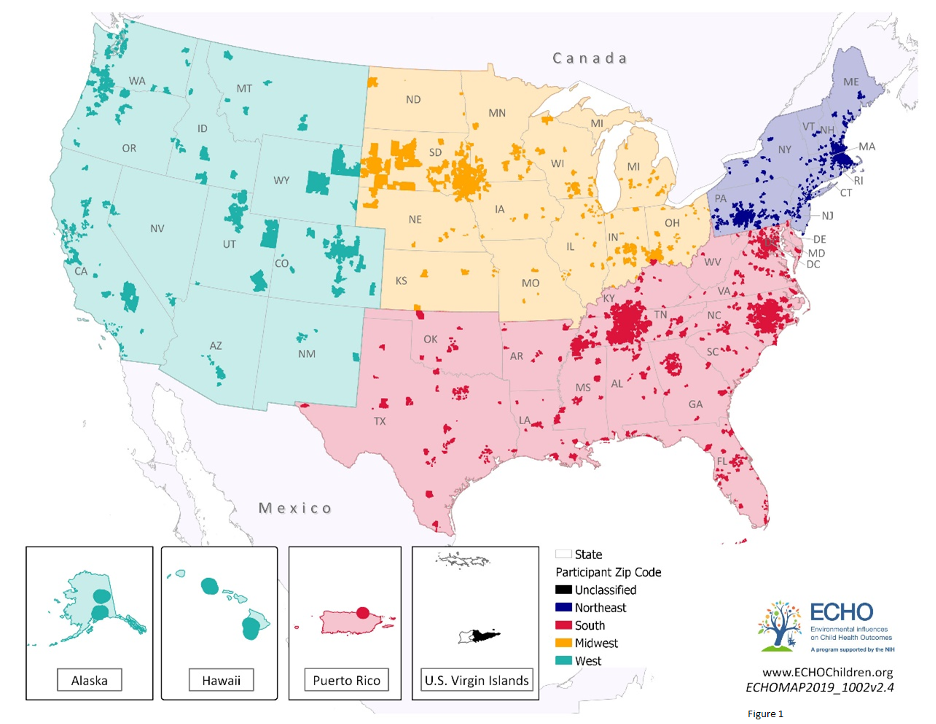
This study included more than 14,000 children and teenagers from birth to age 15. The children lived in the West, South, Northeast, and Midwest regions of the United States. The study included children from different racial and ethnic backgrounds. About half of the children were girls.


Figure 1 This image shows the different regions of the Unites States where study participants lived.


What happened during the study?

Doctors measured children’s height and weight from 2000-2018. The research team used this information to calculate each child’s body mass index (BMI), which is an approximate measure of body fat based on height and weight. The team compared differences in average BMI based on region, mother’s level of education, and demographic factors, including birth weight, race, ethnicity, and sex.


What happens next?

More research is needed to understand exactly how regional environments and policies impact children’s BMI and how local policies contribute to differences in obesity risk based on demographics. Identifying the regional and social factors that result in increased obesity risk can help policymakers and public health officials create ways to prevent obesity.


Where can I learn more?

Access the full journal article, titled “Regional and Sociodemographic Differences in Average BMI Among U.S. Children in the ECHO Program” in Obesity.

The content is the responsibility of the authors and does not necessarily represent the official views of the National Institutes of Health.


Published: August 31, 2021


Access the associated article.

read more summaries here:

Which Children Develop Asthma in the US

Author(s): Christine Cole Johnson and Aruna Chandran

How Environmental Exposures Affect Child Health Across Multiple Generations

Author(s): Carrie Breton, Rebecca Fry, Alison Hipwell, Cristiane Duarte, Linda Kahn, and Joseph Braun

ECHO Research Compares Burden of Parent-Reported Child Diet Assessments

<< Back to Research Summaries

ECHO Research Compares Burden of Parent-Reported Child Diet Assessments

A child’s diet can be an important factor in their overall health, and many ECHO studies investigate what children eat since it relates to different health outcomes. Often, caregivers describe what their child ate of the previous day or week with a questionnaire. These questionnaires rely on parents to remember and estimate when and how much their child ate, which can result in errors. Additionally, it can be hard for parents to accurately report meals and snacks their child ate during school hours because they are not there to observe. More research was needed to better understand barriers to reporting a child’s diet, difficulties with using different reporting tools, and the accuracy and effectiveness of such tools.

Below you will find information on two studies that help answer questions on this topic.

How Can Parents Accurately and Reliably Report on their Child’s Diet?

Author(s): Traci Bekelman, Dana Dabelea, et al.  


Who sponsored this study?

This research was supported by the Environmental influences on Child Health Outcomes (ECHO) program, the Office of the Director, and the National Institutes of Health.


What were the study results?

Parents reported that the strengths of the RFPM included that the RFPM was easy to use and liked that they were not responsible for determining portion sizes. Some of the barriers of RFPM were parents missing photos when they could not see their child’s meal, parents forgetting to take photos, interrupting the child’s eating time, and the child feeling embarrassed to have their meal photographed at school. Parents reported that the strengths of the ASA24 included the ability for them to enter all of the data at once in a single system. Some of the burdens of the ASA24 included the amount of time that parents had to enter information each day and some meal items missing from the website’s database.

Footnote: Results reported here are for a single study. Other or future studies may provide new information or different results. You should not make changes to your health without first consulting your healthcare professional.


What was the study's impact?

This study provided information on the how useful these parent-report tools are for easy and accurate reporting of child diet. Additionally, parents shared some of troubles that may prevent them from accurately recording their child’s meals. These results can also help researchers determine the helpful features and less helpful features of each tool, allowing them to design better child diet studies.


Why was this study needed?

The purpose of this study was to better understand what kept parents from accurately reporting their child’s diet and to identify the burdens the reporting tools put on parents and children.


Who was involved?

This study involved 40 children ages seven or eight in Colorado and Louisiana and their parents.


What happened during the study?

Parents reported on their child’s diet using the Remote Food Photography Method (RFPM) and the Automated Self-Administered 24-hour Dietary Assessment Tool (ASA24). The RFPM involves the parent taking photos of their child’s meals and snacks before and after eating using a smartphone app. The ASA24 involves the parent using a website to describe what their child ate on the previous day, including estimates of what the child ate while not present with the parent. Parents reported on their children’s diet using each of the two methods for three days apiece. Afterwards, parents were given surveys on their experience with the tools, and 32 parents participated in focus group discussions.


What happens next?

Future studies comparing the RFPM and ASA24 should look more closely at whether the burdens and barriers associated with those tools impact the quality and reliability of parent-reported child diet data. The results of this study may also help advance these parent-reported assessments, reducing participant burden and improving the quality of child diet data.


Where can I learn more?

Access the full journal article, titled “A Qualitative Analysis of the Remote Food Photography Method and the Automated Self-Administered 24-hour Dietary Assessment Tool for Assessing Children’s Food Intake Reported by Parent Proxy,” in the Journal of the Academy of Nutrition and Dietetics.

The content is the responsibility of the authors and does not necessarily represent the official views of the National Institutes of Health.

Published November 10, 2021.


A Comparison of Two Methods for Measuring What Children Eat

Author(s): Traci Bekelman, Dana Dabelea, et al.  


Who sponsored this study?

This research was supported by the Environmental influences on Child Health Outcomes (ECHO) program, the Office of the Director, and the National Institutes of Health.


What were the study results?

Caregivers were happy with both methods. Some of the caregivers had challenges with the website technology of the ASA24 and may have reported more food than their child actually ate. When using the RFPM, caregivers were able to photograph most of their child’s meals and snacks, but not all of them.

Footnote: Results reported here are for a single study. Other or future studies may provide new information or different results. You should not make changes to your health without first consulting your healthcare professional.


What was the study's impact?

The researchers intend to use these findings to improve the way child diet is measured and monitored.  Caregivers may need help using the ASA24 website technology or providing the correct details about their child’s diet. Caregivers who use the RFPM may need more reminders to ensure that they photograph their child’s meals and snacks. Caregivers liked both methods, so future improvements will focus on making them both more accurate.


Why was this study needed?

Researchers started using new technologies to measure what children eat, but there is still a lot researchers don’t know about how accurate and burdensome these technologies are for measuring child diet.


Who was involved?

In this study, researchers included parents of children ages seven or eight from cities in Colorado and Louisiana. Most of the caregivers were moms who had at least a college degree.


What happened during the study?

Caregivers tried two ways of measuring what their child ate. The first way was through RFPM, a phone app that required caregivers to photograph their child’s food at the beginning and end of each meal or snack. The second way was through ASA24, which is a website where parents manually entered what their child ate during the previous day. They were then asked to complete a survey on satisfaction, how easy the tools were to use, and what made the tools hard to use.


What happens next?

Researchers will continue to learn about and improve these methods to make them even more accurate while reducing the burden on caregivers.


Where can I learn more?

More information can be found in a webinar previously organized by the National Academies of Sciences, Engineering and Medicine, titled “Approaches to Assessing Intake of Food and Dietary Supplements in Pregnant Women and Children 2 to 11 Years of Age.”

Access the full journal article, titled “A comparison of the Remote Food Photography Method and the Automated Self-Administered 24-hour Dietary Assessment Tool for measuring full day dietary intake among school-aged children,” in the British Journal of Nutrition.

The content is the responsibility of the authors and does not necessarily represent the official views of the National Institutes of Health.

Published June 4, 2021.


Access the associated article.

Download these summaries

ECHO Research Compares Burden of Parent-Reported Child Diet Assessments :
How Can Parents Accurately and Reliably Report on their Child’s Diet? and
A Comparison of Two Methods for Measuring What Children Eat

read more summaries here:

Children’s body mass index: Does it vary by where children live and their individual characteristics?

Author(s): Dana Dabelea, et al.

Which Children Develop Asthma in the US

Author(s): Christine Cole Johnson and Aruna Chandran

How Environmental Exposures Affect Child Health Across Multiple Generations

Author(s): Carrie Breton, Rebecca Fry, Alison Hipwell, Cristiane Duarte, Linda Kahn, and Joseph Braun