ECHO Publication Investigates Regional and Demographic Variations in Children’s Body Mass Index

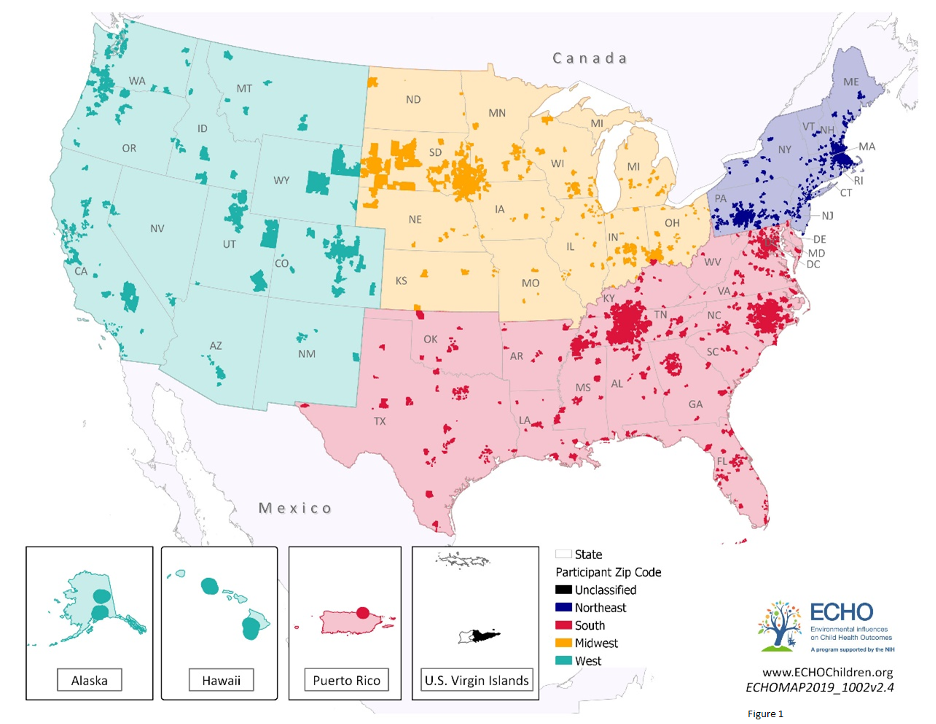
This image shows the different regions of the Unites States where study participants lived.

About 35% of US children are overweight or obese, increasing their lifetime risk for a variety of negative physical and mental health outcomes. Understanding which environmental, social, and cultural factors contribute to childhood obesity can help doctors and policymakers design strategies for early intervention. ECHO researchers Traci Bekelman, PhD, MPH and Dana Dabelea, MD, PhD of the University of Colorado Anschutz; Jody Ganiban, PhD of George Washington University; and their team explored how regional and demographic factors impact children’s weight. Their research, titled “Regional and Sociodemographic Differences in Average BMI Among U.S. Children in the ECHO Program,” is published in Obesity.

During the study, the team analyzed weight and height data doctors collected between 2000 and 2018 from more than 14,000 children and teens from birth to age 15 located across the US in the West, South, Northeast, and Midwest regions. The data incorporated information from children of various racial and ethnic backgrounds, and approximately half of the children were girls. The team used this data to calculate each child’s body mass index (BMI), an approximate measure of body fat based on height and weight. The team then compared these values based on each child’s birth weight, race, ethnicity, sex, home address, and mother’s level of education.

The study found correlations between the children’s BMI and their location. For example, BMI was lowest in the South and West compared to the Northeast. When demographic differences were accounted for, children in the Midwest had higher BMIs compared to children in the Northeast. More work is needed to understand how regional variations in the price and accessibility of food, the opportunities for physical activity, and the school policies and programs impact childhood obesity risk.

The team also found that children who weighed more at birth and children who had less educated mothers had higher BMIs on average. In the Northeast, South, and Midwest, non-Hispanic Black children had higher BMIs than non-Hispanic white children. And in the South and West, BMI was higher on average for Hispanic white children compared to non-Hispanic white children. This research highlights the need for more thorough investigations into how systemic inequalities contribute to obesity risk in children.

“We were surprised that we only found racial and ethnic differences in BMI in some regions,” said Bekelman. “This finding and future studies could help researchers understand the causes of health disparities.” She also noted that the next step for this research is to investigate which specific regional factors and demographic disparities contribute to higher BMIs.


Read the research summary.

Can Maternal Chemical Exposures Affect Birth Weight?

John Pearce
John Pearce, PhD
Medical University of South Carolina

Pregnant women often encounter numerous chemicals that may pose a risk to them and their baby. A subset of these chemicals are endocrine disrupting chemicals (EDC), which can affect health outcomes including growth and development, organ function, metabolism, and reproduction. Thousands of manufactured chemicals in use today are EDCs, and exposures to them are often studied individually. However, this approach is limited since mothers often encounter multiple chemicals in combination (a.k.a., mixtures) during the course of their pregnancy.

To further investigate exposure combinations to EDCs, ECHO researcher John Pearce, PhD of the Medical University of South Carolina and his research team developed a new methodology defined as exposure continuum mapping (ECM) that leverages spatially correlated learning for investigating complex exposure patterns (a.k.a. mixtures) in health studies involving numerous exposures. With this study, Dr. Pearce and his team apply ECM to data collected from a diverse mother-child cohort to identify exposure profiles of real world EDC mixtures and to assess how the discovered profiles associated with birth outcomes.

To begin, the team used data previously collected from over 600 women participating in ECHO that also enrolled in the Eunice Kennedy Shriver National Institute of Child Health and Human Development’s (NICHD) Fetal Growth Studies from 2009-2012. These data included concentrations of EDCs measured in blood samples collected from mothers 8-12 weeks into their pregnancy and their infant’s weight at birth. Then, the team analyzed these data with ECM in order to identify the range of EDC exposure profiles experienced by moms during their pregnancy and to examine the relationship to the birth weight of their children.

Findings from the study revealed that moms experienced a broad range of chemical exposure profiles with marked variability in exposure magnitudes across chemical classes and exposure frequencies. Evaluation of health effects found that maternal exposure profiles dominated by higher levels of flame-retardants (i.e., polybrominated diphenyl ethers, PBDEs) were associated to lower birth weights. Exposure profiles with higher levels of polychlorinated biphenyls (PCBs) and perfluoroakyl (PFAS) substances were associated with increased birth weights. PCBs are man-made chemicals that are often found in industrial and commercial products, such as electrical and hydraulic equipment and plasticizers in paints, plastics, and rubber products. PFAS substances can often be found in food packaging, commercial household products, drinking water, and living organisms.

“ECM provides a promising framework for supporting studies of other exposure mixtures as the resulting mapping benefits visualization and assessment of relationships in complex data,” said Pearce. “Moving forward, our team will apply ECM to assist investigations of exposure mixtures and other child health outcomes, with particular interest on obesity.”

Read the research summary.

ECHO Cohort Examines the Association between Genetic Variants and Wheezing Patterns in Young Children

Brian Hallmark, PhD
Lead Author
University of Arizona

Wheezing is often an early indicator of childhood asthma. While there are several studies looking at patterns of childhood wheezing as well as studies investigating the association between genetic variants and childhood asthma, research is lacking on the direct association between wheezing patterns and genetic variants. To fill this gap, members of ECHO Children’s Respiratory Research and Environment Workgroup (CREW) explored the effect of chromosome 17q12-21 variants, which have been previously linked to childhood asthma, on patterns of wheezing in African American and European American children across the US.

Data collection lasted several years as ECHO CREW sites used questionnaires and interviews to collect information from children and their parents. The researchers harmonized data from the different sites in order to group children based on when and how often they wheezed from birth to 11 years old. Sites also collected DNA samples from most of the children, and researchers analyzed those samples for the presence of nine different small gene changes, also known as single nucleotide polymorphisms (SNPs), at the 17q12-21 chromosome locus. Using statistical techniques, the team then identified different wheezing patterns and measured their association with each of the genetic variants.

Overall, four wheezing patterns were identified among participants:

  1. Infrequent—few wheezing episodes only in the first three years
  2. Transient—some wheezing in first three years, then less, and gone by around six years
  3. Late-onset—little wheezing in the first few years and then gradually occurs more often
  4. Persistent—many wheezing episodes over the first 11 years of life.

These patterns are similar to with the wheezing patterns identified in previous studies that used data collected from other birth cohorts.

Researchers also found that a little more than half of the children experienced wheezing before three years old, and 62% wheezed within the first 10 years of life. Early childhood wheezing often starts due to a viral infection, such as the common cold. Additionally, some children who are diagnosed with asthma may experience transient wheezing patterns that will not last beyond pre-school.

This study was also the first to investigate how genetic variation relates to wheezing patterns in African American children. African American children were statistically more likely than European American children to experience persistent wheezing. While most of the SNPs were associated with transient, late-onset, and persistent wheezing patterns in European American children, only two SNPs were associated with these wheezing patterns in both European American and African American children. One of these SNPs interrupts production of a protein that may be involved in protecting the body from viral infection in the upper airways.

“Asthma is complicated, and susceptible children exposed to hazards such as viruses, allergens, and pollution have more risk of having episodes of wheeze in the preschool years,” said lead author Brian Hallmark, PhD, from the University of Arizona. “Some genetic variations put children at higher risk. The more we understand how asthma develops, the better we can identify and help children at risk and find ways to prevent asthma.”

Not only is this study the first to examine genetic variation and wheezing patterns in African American children, it is also the first to find evidence that genetic variants associated with childhood asthma are also associated with all early life wheezing patterns. These results are found consistently in children from different cities and those born in different decades. In the future, the team will focus on possible associations between children’s insulin levels, genetic variations, and the development of asthma in childhood.

Read the research summary.

ECHO Researcher Publishes Review on Epigenetic and Environmental Influences on Generational Health

Previous studies show that the environment may affect the health of multiple generations in one family. Environmental exposures and behaviors can change a person’s epigenetics, the markers and structural changes that direct how genes are read and understood. These markers and changes form a “molecular memory” can be passed down across generations. For example, if a pregnant woman is exposed to a chemical, her children’s and possibly grandchildren’s health may be impacted through epigenetic changes.

Carrie Breton, ScD

Knowing this, ECHO researcher Carrie Breton, ScD of the University of Southern California and her writing team gathered information from past studies to provide a review of existing epigenetic research and evaluate the potential role of epigenetics in the passing on of health risks to later generations. Breton served as lead author and was accompanied by other ECHO researchers, such as Rebecca Fry, PhD of the University of North Carolina at Chapel Hill; Alison Hipwell, PhD of the University of Pittsburgh; Cristiane Duarte, PhD of Columbia University; Linda Kahn, PhD of NYU Langone Health; Rachel Miller, MD of Icahn School of Medicine at Mount Sinai; and Joseph Braun, PhD of Brown University. Their research, titled “Exploring the evidence for epigenetic regulation of environmental influences on child health across generations” is now published in Communications Biology.

“While complex childhood disorders clearly have genetic components, it is increasingly clear that the environment can play a substantial role in affecting risk, even across generations. Our question was how much evidence exists to support epigenetic mechanisms as one route for conveying that risk,” said Breton.

To collect information, the writing team reviewed several studies on humans and animals investigating the role of epigenetics in multigenerational health. They used these studies to build a broad view of how environmental exposures and behaviors can have a lasting impact on the health and well-being of children for generations to come.

Research from this review found evidence in animals and humans that environmental exposures can affect health across multiple generations, potentially through altered epigenetics. One of the challenges of studying epigenetics in humans is untangling the complex interactions between epigenetic, genetic, and environmental factors associated with certain health outcomes. The scale of the ECHO Program makes it uniquely situated to address questions about environmental exposures across generations.

“By looking at many results together, scientists can find important patterns and form a better understanding of how the environment can affect the health of a mother, child, and grandchild,” said Fry.

Read the research summary.

ECHO Researchers Create a Common Measure of Adult Depression

Courtney K. Blackwell, PhD

More than 264 million people experience depression worldwide. In the United States alone, more than 17 million adults experience depression each year. And women, especially those who are currently or recently pregnant, are at higher risk for a depressive episode. As such, regular depression screenings for women during and after pregnancy is a recommended practice, and doctors may want to continue screening women throughout their lives. Consistent measurement of depression throughout a woman’s lifetime can be difficult because the measurement tools used around pregnancy are scored differently from the common measures of adult depression. Linking these measurement tools together will help doctors track the changes in depression across a woman’s lifetime.

To address this research gap, Courtney K. Blackwell, PhD, and her ECHO colleagues conducted a study aimed at linking the Edinburgh Postnatal Depression Scale (EPDS)—a measure of depression in women during or after pregnancy—with the Patient-Reported Outcomes Measurement Information System Depression (PROMIS-D), a general measure of adult depression.

This study included approximately 1,200 mothers from two ECHO sites in the Northern Plains of the US who each completed the EPDS and PROMIS-D surveys. All data were collected using an online survey. Most of the participants were white, but the sample also included American Indian/Alaska Natives. On average, the participants were 35 years old, and about half had a 4-year college degree or higher.

While the EPDS includes more specific measures of postpartum depression symptoms, the study found that the EPDS and PROMIS-D gave depression scores that were highly correlated for women around pregnancy. Both surveys asked questions about increased depressed mood and decreased interest and engagement in daily activities. The researchers were able to convert EPDS scores to PROMIS-D scores for consistent tracking of depression in women throughout adulthood. The converted scores held for different ages, ethnicities, races, and study sites.

“To know about someone’s depression across time, it is important to have a way to use data from different measures that may have been used at different timepoints,” said Blackwell. “This study provides a way to convert scores from a measure used during and after pregnancy to a measure that is used at any time in adulthood.”

The conversion table may also be useful to ECHO researchers who want to standardize depression measurements from multiple cohort sites. Additional studies may examine how different depression measures can be converted using similar methods.

The conversion table is available on prosettastone.org.


Access the research summary.

ECHO Publication Examines the Relationship between Age, Race, and Childhood Asthma

Asthma is a chronic (long-term) condition that affects the airways in the lungs. Asthma affects people of all ages and often starts during childhood.

Aruna Chandran, MD, MPH
Christine Cole Johnson, PhD, MPH

While many studies have focused on people that already have asthma, it’s also important to know who is at highest risk of getting asthma, so that researchers and doctors can better understand how to prevent it.

To shed light on this topic, ECHO researchers Chris Johnson, PhD, MPH of Henry Ford Health System and Aruna Chandran, MD, MPH of Johns Hopkins University Bloomberg School of Public Health and their team studied which children are at highest risk for getting asthma across the United States. Find their research in JAMA Pediatrics.

To conduct this research, the team gathered information from 24,635 children who were younger than 18 years old and taking part in 31 studies following children over time as part of the ECHO Program. Children shared the age at which they first learned from a doctor they had asthma, as well as their sex, race, and the state in which they lived. Researchers also collected information on their parents’ history of asthma.

“This research opened our eyes to information that was not known before about what groups of children were more likely to get a new asthma diagnosis as they grew up,” said Johnson.

The study found that children with at least one parent with a history of asthma had two to three times higher rates of asthma. This higher risk with family history of asthma mostly affected younger children through age 4. The rates for boys went down with age, but rates for girls stayed about the same. Black children were diagnosed with asthma more than white children during preschool years, but less than white children after age 9-10 years.

“This study adds to our understanding of new cases of asthma. We show that young black children with a parental history have the highest rates,” said Chandran. “Doctors and scientists can use this to focus on helping children at highest risk, working on programs for young children with a focus on Black children whose parents also have asthma.”

If you would like to learn more about asthma in children, please visit the Centers for Disease Control and Prevention’s website. You may also view this video on asthma from the National Heart Lung and Blood Institute (NHLBI).

Read the research summary.

Exploring Gaps in Factors that Affect Pre-Term Birth

Although previous studies show the rates of pre-term birth (PTB) vary based on race and location, little is known about the origin of these differences. Therefore, ECHO researchers Anne Dunlop, MD, MPH, of Emory University, and Alicynne Glazier-Essalmi, of Michigan State University, sought to explore the link between the mother’s socioeconomic status (SES), race, location, and pre-term birth (PTB). Their research, titled “Racial and geographic variation in effects of maternal education and neighborhood-level measures of socioeconomic status on gestational age at birth: Findings from the ECHO cohorts,” is now published in PLoS One.

The participants involved in this study included women enrolled in the ECHO Program who delivered a baby, totaling more than 20,000 mother-infant pairs. These women provided all of the required information about themselves and their infant, including the mother’s age at delivery, education, physical address or region, alcohol use, prenatal care, and the child’s birth sex and gestational age. The research team then took this data and looked for patterns and connections between the given information and factors that affect PTB.

The study found race and ethnicity played a role in how early the child was born. Additionally, compared to non-Hispanic white women, women of all other races had a higher chance of PTB. “Education also played a role,” said Dunlop. “For women overall, a bachelor’s degree or above was linked to less chances of PTB, and a high school education or less led to higher chances of PTB.” This connection between education level and PTB was seen in women who lived in the South and Midwest regions of the United States. Lastly, non-Hispanic white women living in rural areas had a higher chance of PTB delivery compared to women living in urban areas.

“This study explored an important gap in the field of children’s health, as it gathered information on several factors that affect when and if a child is born prematurely,” said Glazier-Essalmi. “Given our findings on education, it is possible that higher education among women could decrease the chances of PTB in the county, especially in the South and Midwest regions.”

Because non-Hispanic Black women, Native American, and Alaskan Native women have the highest rates of PTB, future studies can help identify the causes for this difference and determine ways to prevent PTB in these populations.

Read the research summary here.

Can Multiple Studies Combine Their Results When Their Confounder Adjustment Sets Are Different?

Ghassan Hamra, PhD

In research, directed acyclic graphs typically guide decisions on choosing confounders that need to be adjusted. These graphs also suggest how to get unconfounded, or unbiased, effect estimates, which are based on different statistical models and do not always provide the same actual numeric values. Therefore, Ghassan Hamra, PhD, of Johns Hopkins University Bloomberg School of Public Health, and his team from Wake Forest University and University of California Davis joined together to better understand when these values do and do not correspond.

Their study, “Combining Effect Estimates Across Cohorts and Sufficient Adjustment Sets for Collaborative Research: A Simulation Study” was recently published in the February issue of Epidemiology. To conduct this research, all study data were simulated, and Hamra built all of the models and analyzed all of the information. Ultimately, the team found the estimators showed similar numeric values of the estimates the majority of the time. The exception is when using a model known as logistic regression, which did not give similar estimates. Logistic regression provides an odds ratio, which is a non-collapsible quantity, or one that cannot be reliably combined.

“This study has a significant impact on the ECHO Program, as it allows researchers to understand and combine information across ECHO groups,” said Hamra. In the future, researchers can make additional models to explore other forms of bias that make combining information across studies difficult.

Read the research summary here.

ECHO ACT NOW Current Experience Manuscript Published in Pediatrics

In December, the ECHO IDeA States Pediatric Clinical Trials Network (ISPCTN) published its first ACT NOW Current Experience manuscript, “Site-Level Variation in the Characteristics and Care of Infants with Neonatal Opioid Withdrawal,” in Pediatrics.

The ACT NOW (Advancing Clinical Trials in Neonatal Opioid Withdrawal) Current Experience Study is designed to describe variation in the care of infants with neonatal opioid withdrawal syndrome (NOWS). The data collected were used to inform two of the ACT NOW clinical trials which are currently enrolling and will shape policies, programs, and practices in the care of infants with NOWS.

This cross-sectional study of 1,377 infants with evidence of opioid exposure at 30 participating hospitals nationwide described variation in maternal-infant characteristics, infant management, and outcomes for infants with NOWS.

The study found that sites varied widely in the proportion of infants whose mothers received adequate prenatal care, medication-assisted treatment, and prenatal counseling. Sites also varied in the proportion of infants with toxicology screening and proportion of infants receiving pharmacologic therapy, secondary medications, and non-pharmacologic interventions, including fortified feeds and maternal breast milk. The mean length of stay varied across sites (from two to 29 days), as did the proportion of infants discharged with their parents.

The study concluded that the wide variation in characteristics and treatment makes it unlikely that all infants are receiving efficient and effective care for NOWS. The research suggests that this variation should be considered in future clinical trial development, practice implementation, and policy development.

“Understanding the current landscape of NOWS is critical for future research and the development of programs, policies, and practices to provide better care for these infants,” said Leslie Young, MD, of the University of Vermont. “The degree of variation among infants with NOWS observed in this study shows a significant opportunity to improve the care they receive.”

Also available is a commentary associated with the article, emphasizing the importance of ISPCTN’s work for the field.

Silicone Wristbands Capture Chemical Exposures in Early Pregnancy

Pregnant women are exposed to chemicals that may pose risks to their health or their babies’ health. However, the types of chemicals and the patterns of exposure are not well known. Therefore, ECHO researchers and Opportunities & Infrastructure Fund (OIF) investigators Brett Doherty, PhD, MSPH, and Megan Romano, PhD, MPH of Dartmouth College used silicone wristbands to collect data on chemical exposures during pregnancy. Their research, titled “Assessment of Multipollutant Exposures During Pregnancy Using Silicone Wristbands” is published in Frontiers in Public Health.

During this study, 255 women from the New Hampshire Birth Cohort Study (NHBCS) wore silicone wristbands for one week during early pregnancy. The women went about their normal activities while chemicals in their environment became trapped in the wristbands. At the end of the week, the participants returned the wristbands and the research team measured the captured chemicals.
The study found 199 unique chemicals in the wristbands worn by women in the study. A group of 16 chemicals, including chemicals in personal care products and consumer goods, was identified most often. Most women had relatively low amounts of these chemicals in their wristbands, but others had more unique combinations of chemical exposures. Education and behaviors, such as nail polish use, were predictive of the chemical exposures.

“We identified common exposures and exposure patterns in our study population, which may be studied in future research,” said Romano. The team will compare the wristband measurements to traditional measurements of chemical exposures to better understand the strengths and weaknesses of this new technology.
Additionally, the research team plans to link the chemical exposure data from the silicone wristbands to maternal and infant health outcomes and other biological data. “This linkage may indicate how chemicals influence human health and provide clues to prevent adverse health outcomes,” said Doherty.