


Pregnant Women Living in Worse Neighborhood Conditions Were More Likely to Have Shorter Pregnancies and Smaller Babies

<< Back to Research Summaries

Pregnant Women Living in Worse Neighborhood Conditions Were More Likely to Have Shorter Pregnancies and Smaller Babies

Author(s): Sheena Martenies, et al.


Who sponsored this study?

This research was supported by the Environmental influences on Child Health Outcomes (ECHO) Program, Office of The Director, National Institutes of Health.


What were the study results?

In this study, ECHO researchers found that pregnant participants living in neighborhoods with higher exposure index scores, which reflect worse neighborhood conditions, had shorter pregnancies and smaller babies. For Black pregnant participants, there was a higher risk of preterm birth linked to increased combined exposures during pregnancy compared to White pregnant participants. The researchers also found that pregnant women living in rural areas had shorter pregnancies and smaller babies compared to pregnant women living in urban areas who had similar scores on the combined exposure index.

Footnote: Results reported here are for a single study. Other or future studies may provide new information or different results. You should not make changes to your health without first consulting your healthcare professional.


What was the study's impact?

This study provides additional support suggesting that neighborhood conditions can impact pregnancy and infant health. The effects of combined neighborhood-level exposures on childhood health can have notable effects on a national scale. Lower birthweight and shorter pregnancies are associated with health challenges later in life, including asthma and developmental delays.


Why was this study needed?

Previous studies have found that neighborhood conditions can influence pregnancy and infant health, but few have examined the effects of exposure to a combination of environmental and social stressors. It is important to look at multiple exposures simultaneously because this more closely mirrors real-world experiences on people’s health outcomes.

Existing tools for looking at combined exposures to environmental and social conditions in neighborhoods do not have national coverage or they do not extend across the time frames needed. To address this issue, researchers developed an exposure index to examine the relationship between combined environmental and social exposures at the neighborhood level and pregnancy and infant health in ECHO cohorts.


Who was involved?

This study included more than 13,000 infants born between 2010 and 2019. The participants were from 41 ECHO cohorts located throughout the United States.


What happened during the study?

ECHO researchers developed an exposure index that combined data on multiple environmental hazards and social circumstances into a single measure of neighborhood conditions. The index included factors such as air pollutants, vehicle traffic, poverty, and crowded housing. Pregnant participants were assigned an index score based on where they lived during their pregnancy. Then, the researchers looked at how this index score was associated with birthweight, length of pregnancy, and other pregnancy outcomes.


What happens next?

More research is needed to determine which of the exposures in the index are most important to child health outcomes. Some members of the research team are studying data from two ECHO cohorts to see how these neighborhood-level exposures might interact to influence obesity later in life.


Where can I learn more?

Access the full journal article, titled “Associations between combined exposure to environmental hazards and social stressors at the neighborhood level and individual perinatal outcomes in the ECHO-wide cohort,” in Health & Place.


The content is the responsibility of the authors and does not necessarily represent the official views of the National Institutes of Health.

Published July 21, 2022


Read the associated article.

During the Pandemic, Children Whose Parents Had Flexible Work Schedules and More Financial Security Were More Likely to Have Less Screen Time and More Sleep

<< Back to Research Summaries

During the Pandemic, Children Whose Parents Had Flexible Work Schedules and More Financial Security Were More Likely to Have Less Screen Time and More Sleep

Authors: Traci Bekelman, Katherine Sauder, et al.


Who sponsored this study?

This research was supported by the Environmental influences on Child Health Outcomes (ECHO) Program, Office of The Director, National Institutes of Health.


What were the study results?

Children with parents who were able to change their work schedule to care for their children during the pandemic had less screen time and slept longer at night. Children with parents who were stressed about money and access to food and therefore unable to change their work schedule, drank more sugary drinks, were less active, and slept less at night. Similar to pre-pandemic study results, what children ate and their level of physical activity differed by their age and sex.

Footnote: Results reported here are for a single study. Other or future studies may provide new information or different results. You should not make changes to your health without first consulting your healthcare professional.


What was the study's impact?

This study shows how children’s diet, physical activity, and sleep behaviors during the pandemic were linked to the work schedules and stress of their parents. Parents stressed about money may need help getting their kids to be more active, eat better, use technology less, and sleep more.


Why was this study needed?

The COVID-19 pandemic changed family habits and financial situations for many. ECHO researchers wanted to know how parents' coping strategies, stress, and financial situations affected their children’s health behaviors during the first seven months of the pandemic.


Who was involved?

This study included 3,315 children between 3 and 17 years from 50 ECHO cohorts across the United States. Information about the children’s sex, age, race, and ethnicity were reported by a parent or found in their medical records.


What happened during the study?

Parents answered questions about their child’s diet, physical activity, screen time, and sleep during the first seven months of the COVID-19 pandemic. The parents also described how they were personally coping with the pandemic and what they were most stressed about.


What happens next?

ECHO researchers will continue to look at how financial stress and parents’ work schedules affect children’s health behaviors. This will help guide future strategies to encourage healthy behaviors among children even during stressful times like a pandemic.


Where can I learn more?

Access the full journal article, titled “Sociodemographic Variation in Children's Health Behaviors During the COVID-19 Pandemic,” in Childhood Obesity.


The content is the responsibility of the authors and does not necessarily represent the official views of the National Institutes of Health.

Published July 19, 2022


Access the associated article.

ECHO Study Finds Disparities across Racial, Ethnic Groups in Sleep Duration, Quality During Pregnancy

<< Back to Research Summaries

ECHO Study Finds Disparities across Racial, Ethnic Groups in Sleep Duration, Quality During Pregnancy

Author(s): Maristella Lucchini, et al.


Who sponsored this study?

This research was supported by the Environmental influences on Child Health Outcomes (ECHO) program, Office of The Director, National Institutes of Health.


What were the study results?

Non-Hispanic Black/African American participants slept less and reported more sleep disturbances compared with non-Hispanic White participants. Hispanic participants slept longer, had better sleep quality, and fewer sleep disturbances compared with non-Hispanic White participants.

Footnote: Results reported here are for a single study. Other or future studies may provide new information or different results. You should not make changes to your health without first consulting your healthcare professional.


What was the study's impact?

This study is the first to investigate and report differences in pregnant individuals’ sleep quality across racial and ethnic groups. If these results are replicated in other studies, they may suggest the need for targeted interventions to improve sleep health in pregnancy.


Why was this study needed?

Pregnant women from racial/ethnic minority groups are more likely to experience complications during pregnancy, and poor sleep during pregnancy is known to increase the risk of poor maternal health. People from racial/ethnic minority groups often experience worse sleep compared to non-Hispanic White people, but little is known about differences in sleep during pregnancy.

The objective of this study was to examine whether sleep differences during pregnancy among racial/ethnic groups was a factor that contributed to racial/ethnic disparities in overall maternal health outcomes.


Who was involved?

Researchers analyzed information from 2500 pregnant individuals from 14 ECHO cohorts across the United States who reported on their sleep habits during pregnancy. Participants self-reported race and ethnicity were grouped into Hispanic, non-Hispanic White, non-Hispanic Black/African American, and non-Hispanic Asian individuals.


What happened during the study?

Participants completed questionnaires during pregnancy to report on their sleep duration, quality, and disturbances. Other information collected included maternal education level, pre-pregnancy weight, height, and age.

The researchers evaluated the association between sleep duration, quality, and disturbances in each pregnancy trimester across racial/ethnic groups.


What happens next?

Future studies should research what factors contribute to these sleep disparities at a personal level, family level, and beyond. They should also explore to what extent differences in sleep duration, quality, and disturbances might contribute to disparities in maternal and child health outcomes across racial/ethnic groups.


Where can I learn more?

Access the full journal article, titled “Racial/ethnic disparities in subjective sleep duration, sleep quality and sleep disturbances during pregnancy: an ECHO study” in Sleep.

The content is solely the responsibility of the authors and does not necessarily represent the official views of the National Institutes of Health.

Published June 21, 2022


Read the associated article.

Read More Research Summaries

The influence of sleep on children’s well-being

Author: Courtney K. Blackwell

The Relationship between Neighborhoods and Asthma Occurrence in Children

Author(s): Antonella Zanobetti, Patrick H. Ryan, et al.

Which Children Develop Asthma in the US

Author(s): Christine Cole Johnson and Aruna Chandran

ECHO Study Links Poor Neighborhood Conditions With Higher Risk of Asthma in Children

<< Back to Research Summaries

ECHO Study Links Poor Neighborhood Conditions With Higher Risk of Asthma in Children

Author(s): Antonella Zanobetti, Patrick H. Ryan, et al


Who sponsored this study?

This research was supported by the Environmental influences on Child Health Outcomes (ECHO) program, Office of The Director, National Institutes of Health.


What were the study results?

Of the 5,809 children studied, 46% experienced wheezing in their first year of life, with 26% having wheezing through age 11. Diagnosis of asthma by age 11 varied by cohort, with an overall median prevalence of 25%. Children in neighborhoods with more people, and with more families with lower incomes, experienced more asthma and early and persistent wheezing. Black and Hispanic children remained at higher risk for asthma than White children, even in wealthier neighborhoods.

Footnote: Results reported here are for a single study. Other or future studies may provide new information or different results. You should not make changes to your health without first consulting your healthcare professional.


What was the study's impact?

This study suggests that neighborhood characteristics at birth and race/ethnicity play a role in the development of childhood wheezing and asthma. This information can help inform strategies to reduce childhood asthma, including strategies that address the socioeconomic factors that create higher risks for Black and Hispanic children.


Why was this study needed?

In the United States, Black and Hispanic children have higher rates of asthma compared to White children and more often live in communities where households struggle to meet their basic needs. The objective of this study was to explore how much neighborhood-level socioeconomic factors, like income and education, contribute to differences in childhood wheezing and asthma between Black, White, and Hispanic children.


Who was involved?

Almost 6,000 children across the United States born between the 1980s and 2010s.


What happened during the study?

The team used questionnaires and interviews to collect information such as wheezing and asthma occurrence, medical history, and demographics. Each child’s home address was matched to U.S. Census data for the decade closest to their birth year. Researchers studied how children’s race/ethnicity and their mother’s education level and smoking habits, plus their neighborhood socioeconomic conditions, were related to wheezing – a symptom involving whistling breathing sounds due to narrowed airways – and asthma.


Where can I learn more?

Access the full journal article, titled “Childhood Asthma Incidence, Early and Persistent Wheeze, and Neighborhood Socioeconomic Factors in the ECHO/CREW Consortium” in JAMA Pediatrics.

The content is solely the responsibility of the authors and does not necessarily represent the official views of the National Institutes of Health.

Published May 23, 2022


Read the associated article.

Read More Airways Research Summaries

A Nationwide Study on How Childhood Asthma Relates to Obesity Development 

Author(s): Nikos Stratakis and Erika Garcia

Which Children Develop Asthma in the US

Author(s): Christine Cole Johnson and Aruna Chandran

Location of Wheezing Gene Linked to Different Wheezing Patterns in Young Children

Author(s): Brian Hallmark, et al.

Review of Prenatal Air Pollution Exposure and Brain Development

Author(s): Heather E. Volk, Frederica Perera, Joseph M. Braun, Samantha L. Kingsley, Kim Gray, Jessie Buckley, Jane E. Clougherty, Lisa A. Croen, Brenda Eskenazi, Megan Herting, Allan C. Just, Itai Kloog, Amy Margolis, Leslie A. McClure, Rachel Miller, Sarah Levine, Rosalind Wright

Age is a factor in whether children get infected with the common cold

Author(s): Timothy Choi, James E. Gern and Yury A. Bochkov

Update on Vitamin E and Its Potential Role in Preventing or Treating Bronchopulmonary Dysplasia

Author(s): Cosby Stone, Cynthia McEvoy, Judy Aschner, et al

ECHO Study Identifies Biological, Behavioral, and Social Factors Affecting Pregnancy Health

<< Back to Research Summaries

ECHO Study Identifies Biological, Behavioral, and Social Factors Affecting Pregnancy Health

Authors: Stephanie Eick, Rachel Morello-Frosch, et al.


Who sponsored this study?

This research was supported by the Environmental influences on Child Health Outcomes (ECHO) program, Office of The Director, National Institutes of Health.


What were the study results?

Pregnant participants who were over 30 years old and had a college degree had lower levels of oxidative stress. Levels of oxidative stress were higher among pregnant participants who were overweight or obese and unmarried. Also, current smokers or those with less than a high school education had higher levels of a oxidative stress biomarker. These results help identify how social, biologic, and behavioral factors may contribute to poor health in mothers and children.


Footnote: Results reported here are for a single study. Other or future studies may provide new information or different results. You should not make changes to your health without first consulting your healthcare professional.


What was the study's impact?

This is the largest study to date looking at the relationship between biological, social, and behavioral factors and oxidative stress during pregnancy. The results of this study provide important clues into how socioeconomic inequalities can contribute to poor health in pregnant women. This study may also inform future studies looking at risk factors for preterm birth.


Why was this study needed?

There is little data on what can cause oxidative stress during pregnancy. Oxidative stress is a process that can trigger cell damage and it is thought to play a role in the development of some diseases. By identifying biological, behavioral, and socioeconomic factors in a mother’s day-to-day life that may lead to increased risk for oxidative stress, research can help inform the development of targeted strategies for the prevention of poor prenatal health outcomes.


Who was involved?

This study involved approximately 2,000 pregnant participants in the mainland United States and Puerto Rico who were enrolled in one of four ECHO cohorts.


What happened during the study?

Researchers collected urine samples from participants and measured the levels of biomarkers for oxidative stress. Researchers calculated how levels of oxidative stress biomarkers changed in response to biological, behavioral, and social factors. Maternal age, pre-pregnancy body mass index, marital/partnered status, parity, and smoking status were included as biological and behavioral factors while race/ethnicity, maternal education, and stressful life events were considered social factors.


What happens next?

The research team is examining the impact of oxidative stress on adverse pregnancy outcomes, such as preterm birth.


Where can I learn more?

The full journal article, titled “Associations between social, biologic, and behavioral factors and biomarkers of oxidative stress during pregnancy: Findings from four ECHO cohorts” is published in Science of the Total Environment.


The content is the responsibility of the authors and does not necessarily represent the official views of the National Institutes of Health.

Published April 29, 2022

Access the associated article.

Read More Research Summaries

Study Reveals Rising Levels of Plastics, Pesticides, and Replacement Chemicals in Pregnant Women

Author(s): Jessie P. Buckley, Tracey J. Woodruff, et al.

Effects of Metal Mixture Exposure During Pregnancy on Fetal Growth

Authors: Caitlin Howe, Margaret R. Karagas, et al.

Exposures to environmental chemicals and their effect on important molecules during pregnancy

Author(s): Brett T. Doherty, Megan E. Romano, et al.

Do chemicals that break down slowly in the environment affect how long it takes to become pregnant?  

Author(s): Linda Kahn, Alison Hipwell, Kim Harley, Pam Factor-Litvak, Michele Klein-Fedyshin, Christine Porucznik, Eva Siegel, Yeyi Zhu

A review of studies that look at whether exposure to common non-persistent chemicals in consumer products delays the time it takes to become pregnant

Author(s): Alison E. Hipwell, Linda G. Kahn, Pam Factor-Litvak, et al

Informed Mothers More Likely to Engage in Collective Action, Reduce Family- and Community-Level Chemical Exposures

<< Back to Research Summaries

Informed Mothers More Likely to Engage in Collective Action, Reduce Family- and Community-Level Chemical Exposures

Authors: Amy Padula, Rachel Morello-Frosch, et al.


Who sponsored this study?

This research was supported by the Environmental influences on Child Health Outcomes (ECHO) program, the Office of the Director, and the National Institutes of Health.


What were the study results?

This study found that participants knew about the dangers of chemical exposures and were motivated to act to protect the health of their families and communities, although they have busy family lives, and the pandemic has further prevented them from participating in collective action. Participants requested strategies that were time-efficient and included straightforward, accessible information on how to reduce exposures at the personal and community level.

Footnote: Results reported here are for a single study. Other or future studies may provide new information or different results. You should not make changes to your health without first consulting your healthcare professional.


What was the study's impact?

Researchers have an opportunity to directly learn from participants about how to improve the way in which chemical exposure results are reported in future studies. Report-back systems, or ways that study results are returned to participants, can present valuable information for participants about environmental health and how to lower chemical exposures in their homes and communities, and hold policy makers responsible for protecting parents and children from harmful chemical exposures. Researchers can use tools like the Digital Exposure Report Back Interface (DERBI) to give their participants access to individualized chemical results with information about how to take individual and collective action to reduce exposures.


Why was this study needed?

Participants in chemical exposure studies who receive reports on their personal exposures often look for information to reduce those exposures. Many chemical exposures are the result of policies, regulations, and practices, not individual behaviors and lifestyles. Individuals can address those policies and regulations through collective action, which is working with others to reach a common goal. Researchers wanted to understand the role of personal exposure reports in a participant’s interest in engagement in collective action.


Who was involved?

In summer 2020, the researchers held three online focus groups in English and Spanish with a diverse group of 18 participants from pregnancy cohorts in Illinois and California.


What happened during the study?

This study aimed to understand how much participants know about sources of potentially harmful chemical exposures and their experience and interest in participating in collective action. Focus group participants talked about some of the barriers and strategies to participating in collective action, and their preferences for receiving and using their personalized reports about environmental chemical exposures. Input from these focus groups can be used to help design tools and content to report results of exposure research to ECHO participants.


What happens next?

The researchers are currently studying participant surveys from before and after participants received their chemical exposure reports to learn more about how participants use DERBI. These surveys may also reveal how DERBI reports may influence participant efforts to reduce exposure in their homes and communities through collective action.


Where can I learn more?

More information about the Digital Exposure Report Back Interface (DERBI) can be found on the Silent Spring Institute website.

Access the full journal article, titled “Perspectives of peripartum people on opportunities for personal and collective action to reduce exposure to everyday chemicals: Focus groups to inform exposure report-back” in Environmental Research.


The content is the responsibility of the authors and does not necessarily represent the official views of the National Institutes of Health.

Published March 26, 2022

Access the associated article.

Read More Research Summaries about Chemical Exposures and Pregnancy

Study Reveals Rising Levels of Plastics, Pesticides, and Replacement Chemicals in Pregnant Women

Author(s): Jessie P. Buckley, Tracey J. Woodruff, et al.

Effects of Metal Mixture Exposure During Pregnancy on Fetal Growth

Authors: Caitlin Howe, Margaret R. Karagas, et al.

Exposures to environmental chemicals and their effect on important molecules during pregnancy

Author(s): Brett T. Doherty, Megan E. Romano, et al.

Do chemicals that break down slowly in the environment affect how long it takes to become pregnant?  

Author(s): Linda Kahn, Alison Hipwell, Kim Harley, Pam Factor-Litvak, Michele Klein-Fedyshin, Christine Porucznik, Eva Siegel, Yeyi Zhu

A review of studies that look at whether exposure to common non-persistent chemicals in consumer products delays the time it takes to become pregnant

Author(s): Alison E. Hipwell, Linda G. Kahn, Pam Factor-Litvak, et al

Families Who Had More COVID-19 Pandemic-Related Hardships Had More Stress, Lower Child Life Satisfaction

<< Back to Research Summaries

Families Who Had More COVID-19 Pandemic-Related Hardships Had More Stress, Lower Child Life Satisfaction

Author(s): Courtney K. Blackwell, et al.


Who sponsored this study?

This research was supported by the Environmental influences on Child Health Outcomes (ECHO) program, Office of The Director, National Institutes of Health, with co-funding from the Office of Behavioral and Social Sciences Research (OBSSR).

Footnote: The content is solely the responsibility of the authors and does not necessarily represent the official views of the National Institutes of Health.


What were the study results?

Families with more COVID-19 pandemic-related hardships had higher levels of caregiver and child stress and lower child life satisfaction. Children who had higher levels of social connection and family engagement had better life satisfaction. For younger children, family engagement also decreased the negative effect of stress on life satisfaction. For adolescents, having anxiety and/or depression was a risk factor associated with lower life satisfaction during the pandemic.

Footnote: Results reported here are for a single study. Other or future studies may provide new information or different results. You should not make changes to your health without first consulting your healthcare professional.


What was the study's impact?

This study demonstrated the different ways caregivers, children, and adolescents have coped with stress and adapted to the COVID-19 pandemic. The results of this study highlight the importance of family engagement and peer social connection in promoting children’s well-being during adverse events. This study also showed that stress and well-being are not direct opposites, suggesting the need for interventions that can both decrease children’s stress and improve their well-being.


Why was this study needed?

Families have faced many challenges during the COVID-19 pandemic, but we don’t yet know much about how these challenges have impacted children’s mental health. While negative mental health outcomes are important to research, it is just as important to understand what helps children maintain positive mental health during hard times. This study investigated how the impact of COVID-19 pandemic-related family hardships have affected child and adolescent well-being and identified factors that can improve and protect their well-being during difficult times.


Who was involved?

This study surveyed 977 caregivers of children ages 2 to 12 from 11 ECHO cohorts and 669 adolescents ages 11-17 and their caregivers from five ECHO cohorts. These participants came from 30 U.S. states.


What happened during the study?

The researchers collected survey data from May 2020 to May 2021. These surveys asked each participant about their family’s COVID-19 pandemic experience. The researchers combined data from the different cohorts to look at how pandemic-related sources of stress (also called “hardships”) were related to caregiver and child stress, and how stress, social connection, family engagement, and pre-existing mental health conditions related to children’s life satisfaction.


What happens next?

The next steps for this research include looking at which specific COVID-19 family hardships have the most impact on caregiver and child stress and well-being so that we can design more specific interventions.


Where can I learn more?

Access the full journal article, titled “Youth well-being during the COVID-19 pandemic” in Pediatrics.

 The content is the responsibility of the authors and does not necessarily represent the official views of the National Institutes of Health.

Published: March 18, 2022


Read the associated news article.

ECHO Study Identifies Demographics of Pregnant Women Least Likely to Get the Nutrients They Need

<< Back to Research Summaries

ECHO Study Identifies Demographics of Pregnant Women Least Likely to Get the Nutrients They Need

Author(s): Katherine Sauder, et al.


Who sponsored this study?

This research was supported by the Environmental influences on Child Health Outcomes (ECHO) program, Office of The Director, National Institutes of Health.


What were the study results?

More than one in every five pregnant women did not eat enough of the vitamins D, E, K, and choline and the minerals magnesium and potassium, even when taking dietary supplements. The women most likely to not get enough vitamins and minerals were those aged 14-18 years, those who were Hispanic or Black, those who had less than a high school education, and those with obesity. Non-Hispanic women were the most likely to eat too much folic acid.

Footnote: Results reported here are for a single study. Other or future studies may provide new information or different results. You should not make changes to your health without first consulting your healthcare professional.


What was the study's impact?

The study showed that many pregnant women are at a high risk of not getting enough nutrients from food alone, so it is important for pregnant women to improve their diet quality and take dietary supplements when needed. The risk of not getting enough vitamins or minerals for women of various ages, races/ethnicities, education levels, or weights is often a problem, even when using dietary supplements.

This study shows that the dietary supplements women use today do not help them get all the nutrients they need in the right amounts. Pregnant women need guidance specific to their bodies to manage the vitamins and supplements they need. Different combinations and formulas of dietary supplements taken before getting pregnant may also help this problem and make sure women do not receive too much folic acid, iron, and zinc.


Why was this study needed?

One in three pregnant women in the United States eats too little or too many key vitamins and minerals. Prior studies do not tell us what groups are at the most risk for poor nutrition during pregnancy. Knowing who is at risk for poor nutrition can make it easier for doctors and public health workers to help pregnant women manage their nutrition.


Who was involved?

The researchers studied 9,801 women aged 14-50 years living across the United States who were pregnant between 1999 and 2019.


What happened during the study?

Pregnant women reported their daily food and dietary supplement intake during pregnancy. Researchers compared their daily intake of 19 vitamins and minerals to the Institute of Medicine recommendations for pregnant women.


What happens next?

The researchers will study how much vitamins and minerals women are getting from foods and compare this amount to the amount pregnant women should get. They will identify dietary supplements that can give women the right amounts of the vitamins and minerals they need.


Where can I learn more?

Access the full journal article, titled “Disparities in risks of inadequate and excessive intake of micronutrients during pregnancy” in Journal of Nutrition.


The content is the responsibility of the authors and does not necessarily represent the official views of the National Institutes of Health.


Published September 7, 2021


Access the associated article.

Read More Research Summaries about Pregnancy

How Chemical Exposures in Pregnancy Affect Gene Changes in the Placenta

Author(s): Alison Paquette, Sheela Sathyanarayana, MD, MPH, et al.

Do chemicals that break down slowly in the environment affect how long it takes to become pregnant?  

Author(s): Linda Kahn, Alison Hipwell, Kim Harley, Pam Factor-Litvak, Michele Klein-Fedyshin, Christine Porucznik, Eva Siegel, Yeyi Zhu

A review of studies that look at whether exposure to common non-persistent chemicals in consumer products delays the time it takes to become pregnant

Author(s): Alison E. Hipwell, Linda G. Kahn, Pam Factor-Litvak, et al

Nationwide ECHO Study Suggests Children in the Western and Southern U.S. May Have Lower Body Mass Index Than Children in the Northeast

<< Back to Research Summaries

Nationwide ECHO Study Suggests Children in the Western and Southern U.S. May Have Lower Body Mass Index Than Children in the Northeast

Author(s): Dana Dabelea, Jody Ganiban, Traci Bekelman, et al.


Who sponsored this study?

This research was supported by the Environmental influences on Child Health Outcomes (ECHO) program, Office of The Director, National Institutes of Health.


What were the study results?

BMI was lowest for children in the West and South compared to those in the Northeast. When demographic differences were accounted for, children in the Midwest had higher BMIs than those in the Northeast. Across all regions, BMI was highest in children who weighed more at birth and children with less educated mothers. In the Northeast, South, and Midwest, non-Hispanic Black children had higher BMIs on average compared to non-Hispanic white children. In the South and West, BMI was higher for Hispanic white children compared to non-Hispanic white children.


What was the study's impact?

This study revealed some of the regional and demographic factors influencing childhood obesity and overweight. The regional differences in children’s BMI suggest that their surroundings, cultures, and relationships affect the development of childhood obesity. These differences could potentially be linked to variations in food prices, fast food options, and opportunities to exercise.


Why was this study needed?

About 35% of US children are overweight or obese. Childhood obesity can have serious physical and mental health effects that can follow children into adulthood. Understanding the factors that affect children’s weight, can help us create ways to prevent obesity. This study looked at factors related to children’s weight where children live, how much they weighed at birth, and their ethnic background.


Who was involved?

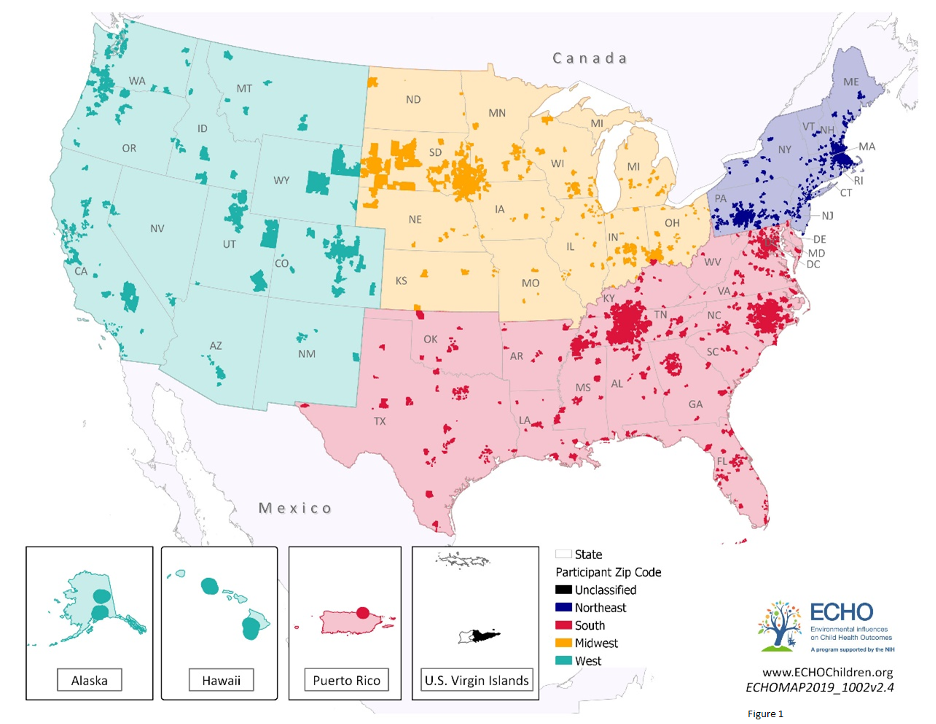
This study included more than 14,000 children and teenagers from birth to age 15. The children lived in the West, South, Northeast, and Midwest regions of the United States. The study included children from different racial and ethnic backgrounds. About half of the children were girls.


Figure 1 This image shows the different regions of the Unites States where study participants lived.


What happened during the study?

Doctors measured children’s height and weight from 2000-2018. The research team used this information to calculate each child’s body mass index (BMI), which is an approximate measure of body fat based on height and weight. The team compared differences in average BMI based on region, mother’s level of education, and demographic factors, including birth weight, race, ethnicity, and sex.


What happens next?

More research is needed to understand exactly how regional environments and policies impact children’s BMI and how local policies contribute to differences in obesity risk based on demographics. Identifying the regional and social factors that result in increased obesity risk can help policymakers and public health officials create ways to prevent obesity.


Where can I learn more?

Access the full journal article, titled “Regional and Sociodemographic Differences in Average BMI Among U.S. Children in the ECHO Program” in Obesity.

The content is the responsibility of the authors and does not necessarily represent the official views of the National Institutes of Health.


Published: August 31, 2021


Access the associated article.

read more summaries here:

Which Children Develop Asthma in the US

Author(s): Christine Cole Johnson and Aruna Chandran

How Environmental Exposures Affect Child Health Across Multiple Generations

Author(s): Carrie Breton, Rebecca Fry, Alison Hipwell, Cristiane Duarte, Linda Kahn, and Joseph Braun

ECHO Study Identifies Demographics of Children Most Likely to Develop Asthma

<< Back to Research Summaries

ECHO Study Identifies Demographics of Children Most Likely to Develop Asthma

Author(s): Christine Cole Johnson and Aruna Chandran


Who sponsored this study?

This research was supported by the Environmental influences on Child Health Outcomes (ECHO) program, Office of The Director, National Institutes of Health.


What were the study results?

The study found that children with at least one parent with a history of asthma had two to three times higher rates of asthma. This higher risk with family history of asthma mostly affected younger children, through four years old. The rates for boys went down with age, but rates for girls stayed about the same, so by the teenage years girls developed asthma more often than boys. Black children were diagnosed with asthma more than white children during preschool years, but less than white children after age 9-10 years.

Footnote: Results reported here are for a single study. Other or future studies may provide new information or different results. You should not make changes to your health without first consulting your healthcare professional.


What was the study's impact?

This study helps us understand what groups of children are more likely to get asthma. The research shows that young Black children and young children whose parents had asthma develop asthma more often than other groups. Researchers can work to develop new asthma programs to help keep children at highest risk from getting asthma.


Why was this study needed?

Childhood asthma is a major cause of suffering, missed school for children, and missed work for parents. Researchers and doctors need to understand who is more likely to get asthma, not just focus on who already has it, as other studies have done. Knowing this information is a step to finding out why certain kids get asthma and preventing it. Using information from children from diverse backgrounds in the United States, this paper describes which children developed asthma from early childhood through adolescence.


Who was involved?

Children younger than 18 years old taking part in 31 studies within the ECHO program


What happened during the study?

The research team found out the ages when children learned from a doctor they had asthma, and the children’s race, sex, and what state they lived in. It was also important to collect information on whether their parents had asthma or not.


What happens next?

Researchers should work on asthma prevention programs for very young children, especially Black children and those whose parents have had asthma.


Where can I learn more?

If you would like to learn more about asthma in children, please visit the Centers for Disease Control and Prevention or the National Heart Lung and Blood Institute (NHLBI).

Access the full journal article, titled “Childhood Asthma Incidence Rate Patterns from the ECHO Consortium: Identifying High-Risk Groups for Primary Prevention.”

The content is solely the responsibility of the authors and does not necessarily represent the official views of the National Institutes of Health.


Published: May 17, 2021

Read More Airways Research Summaries

Location of Wheezing Gene Linked to Different Wheezing Patterns in Young Children

Author(s): Brian Hallmark, et al.

Review of Prenatal Air Pollution Exposure and Brain Development

Author(s): Heather E. Volk, Frederica Perera, Joseph M. Braun, Samantha L. Kingsley, Kim Gray, Jessie Buckley, Jane E. Clougherty, Lisa A. Croen, Brenda Eskenazi, Megan Herting, Allan C. Just, Itai Kloog, Amy Margolis, Leslie A. McClure, Rachel Miller, Sarah Levine, Rosalind Wright

Age is a factor in whether children get infected with the common cold

Author(s): Timothy Choi, James E. Gern and Yury A. Bochkov

Update on Vitamin E and Its Potential Role in Preventing or Treating Bronchopulmonary Dysplasia

Author(s): Cosby Stone, Cynthia McEvoy, Judy Aschner, et al